

Norwood, MA
Porch Floor, Steps & Railings in Norwood, MA
A Norwood home's front and back porches: floor boards and steps painted gray, with railings, balusters and lattice skirting in white.
See the photos →Siding, trim and porches prepared and painted for a housing stock that runs from pre-1940 construction to 1980s and newer builds.
Clinton was incorporated in 1850 and grew as a mill town on the Nashua River, known by 1890 for carpets and woven wire. The buildings from that era still shape what exterior painters meet today: about 37% of the town's housing units were built in 1939 or earlier, per Census estimates. A house that old has had decades of recoating, and its exterior is as much a preparation job as a painting job.
On aged clapboard and wood trim, paint failure shows up as alligatored film, peeling at butt joints, and bare gray wood near the ground and under rooflines. Each one points to a different cause. Peeling around windows and corners often follows moisture getting behind the paint, while chalky, thin paint on a sunny wall is simply worn out.
The fix is rarely 'one more coat.' Loose paint is scraped back to a sound edge, bare wood is spot-primed, open joints are caulked with a flexible exterior sealant, and rotted boards are flagged for carpentry before painting. We cover the full sequence on our Massachusetts exterior painting cost guide, which also explains why preparation is most of the labor.
Around 72% of Clinton's housing units were built before 1980, which puts many exteriors in lead-paint territory. Scraping and sanding exterior paint on a pre-1978 house releases dust and chips into soil and gutters, so plastic ground cover, wet scraping and magnetic sweeping of the yard apply. Our lead-safe painting page describes the steps, and the EPA's RRP program is the governing federal rule.
Several Clinton landmarks are on the National Register of Historic Places, including the Downtown Clinton Historic District along High Street, with 31 contributing buildings, and the Lancaster Mills complex, whose brick Italianate buildings date to the 1840s. National Register listing by itself does not dictate what color a private owner may paint, and this page does not confirm whether Clinton has any local historic district rules. If your building is a listed or contributing property, or you plan to apply for preservation tax credits, check requirements with the Clinton Historical Commission before choosing materials or colors.
Brick is its own case. Painted brick needs breathable masonry paint, while unpainted historic brick generally should not be sealed in a film that traps moisture. We would rather talk through that on-site than apply a coating that causes spalling later.
Nearly a quarter of units are in two-to-four-unit buildings, and a building with three floors or stacked porches takes scaffolding or lifts to reach upper eaves, which affects scheduling. Owners of multi-families should plan around tenants' parking, porch use and window access during the work.
Exterior coatings need dry surfaces and moderate temperatures, so New England painting runs from spring through fall. Weather matters more than the calendar, and a free on-site visit gives you a written scope covering prep, repairs and coatings. For painters near the city center, see downtown Clinton painters; for the interior side of an older house, see interior painting in Clinton.
| Housing units built in 1939 or earlier | 37.3% (2,605 of 6,977 units) (U.S. Census ACS 2020–2024 5-year (via Census Reporter)) |
| Housing units built before 1980 | 71.6% (4,996 of 6,977 units) (U.S. Census ACS 2020–2024 5-year (via Census Reporter)) |
| Downtown Clinton Historic District | National Register #85000319, listed 1985; 31 contributing buildings (National Park Service NPGallery) |
| Lancaster Mills | National Register #10000005, listed 2010; brick Italianate mills built 1844–1848 (National Park Service NPGallery) |
| Units in 2 to 4 unit buildings | 23.9% (1,669 units) (U.S. Census ACS 2020–2024 5-year (via Census Reporter)) |
These jobs were in other towns, not in Clinton. Each card names the town where the work was done.
A Norwood home's front and back porches: floor boards and steps painted gray, with railings, balusters and lattice skirting in white.
See the photos →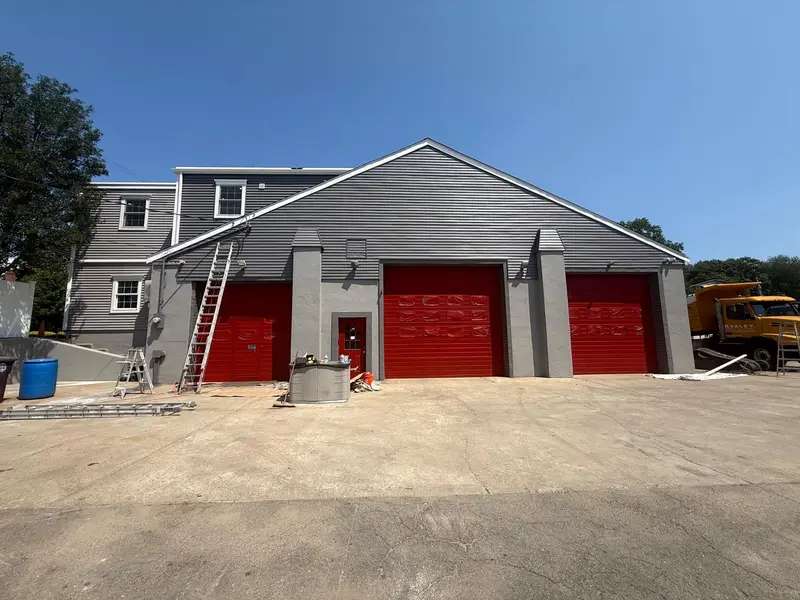
A garage building in Weymouth with white overhead doors and masonry pilasters whose paint was peeling. The doors and service doors were painted red and the pilasters refinished in gray.
See the photos →National Register listing alone does not regulate private paint colors, and we could not confirm whether Clinton has a local historic district bylaw. Because of that, contact the Clinton Historical Commission if your property is listed or you are using preservation incentives.
Loose paint is scraped to a sound edge, bare wood is primed, joints are caulked, and rotted boards are replaced before the finish coats. Painting over unstable paint just moves the failure date forward by a season or two.
It can be on anything built before 1978, and about 72% of Clinton's housing units were built before 1980. Lead-safe work uses ground containment, wet scraping and cleanup that captures chips, as described on our lead-safe page.
Yes, with a breathable masonry coating, but painting changes how the wall handles moisture and is hard to reverse. Unpainted historic brick is usually better left uncoated, and we will tell you which case you have.
Our estimate comes after we see the house. For a general range, Massachusetts market data on the exterior cost page breaks costs down by size, siding and repair needs.
Surfaces must be dry and temperatures within the coating's stated range, so spring, summer and early fall are the workable window. Exact timing depends on the forecast.
Call (508) 258-4325, Monday to Saturday, 7AM to 6PM, or request a visit online.
5.0 on Google · 35 verified reviews · Licensed & insured · Written quote in 48h