
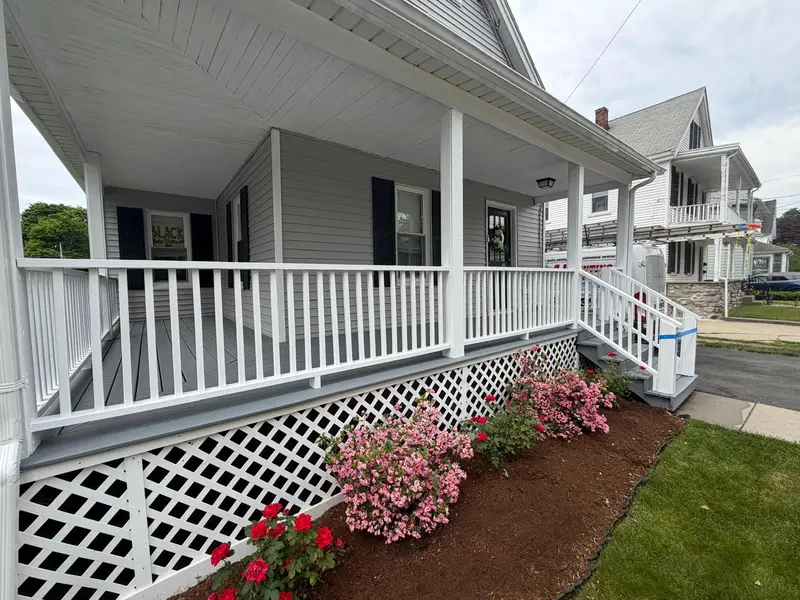
Norwood, MA
Porch Floor, Steps & Railings in Norwood, MA
A Norwood home's front and back porches: floor boards and steps painted gray, with railings, balusters and lattice skirting in white.
See the photos →Siding, trim, sash and porches on Cambridge houses, with color and prep planned around the Historical Commission's districts where they apply.
The Cambridge Historical Commission, set up in 1963, oversees more than 3,100 buildings in two local historic districts (Old Cambridge and Fort Washington), four neighborhood conservation districts (Avon Hill, Half Crown-Marsh, Harvard Square and Mid Cambridge) and individually designated landmarks. Whether the color on your clapboards is anyone else's business depends on which of those lines your lot falls inside, so that question comes before scraping starts.
Outside the districts, color is generally the owner's call, though the Commission notes that some properties under preservation easements also need their paint colors approved. Inside the districts, the rules differ from one to the next, and the differences are worth knowing before choosing colors.
In the Old Cambridge Historic District, which takes in most of Brattle Street, the Common and its surroundings, Berkeley and Follen Streets, and parts of Elmwood Avenue, Craigie Street, Garden Street and Harvard Yard, every exterior change is reviewed whether or not a building permit is needed. The Commission's list names paint color specifically, along with storm windows and gutters. Exterior colors there have to be approved by the Commission.
In the small Fort Washington Historic District, paint is among the publicly visible changes the Commission regulates, and a certificate has to be issued before the work goes ahead. The Half Crown-Marsh conservation district, west of Harvard Square, does not review most repairs or paint colors. In Mid Cambridge, work done in kind, matching what exists exactly, and changes not visible from a public way receive a Certificate of Non-Applicability. The city's pages do not say whether paint color is reviewed in Avon Hill or the Harvard Square district, so owners there should ask Commission staff before committing to a new scheme.
Even where approval is not required, the Commission's painting guidance is a useful reference. It advises that, with few exceptions, 19th- and early 20th-century houses take a three-color scheme: one color for the body, one for all decorative trim, and a third for sash and doors, meaning only the movable parts of windows and doors. Giving the sash its own color changes how a facade reads from the street.
Any Cambridge owner can book a one-hour on-site color consultation with Commission staff, which includes a follow-up letter and a later look at paint samples on the house. It is free for properties where color approval is required and $100 for everyone else.
A Commission staff memo citing its Northwest Cambridge survey counts more than a thousand two-family houses built in North and West Cambridge between 1885 and 1935. Around the Huron Avenue streetcar line, the turn-of-the-century stock is Queen Anne two-families and Colonial Revival triple-deckers. When a building of that type rises several stories of clapboard or shingle, with porches and plenty of trim per wall, staging and ladder access drive the schedule as much as square footage does.
Wood shingles and clapboards are scraped to sound paint, bare wood is spot-primed, open joints are caulked, and then two finish coats go on. Where siding is shingle, the choice between solid stain and paint depends on what is already on the wall: stain cannot soak into shingles that have been painted, so going back to stain means removing the paint first.
Census estimates show 67.9% of Cambridge homes built before 1980. On a pre-1978 house, scraping more than 20 square feet of exterior paint brings in the EPA's lead-safe work rules: ground sheeting, containment of chips and debris, and cleanup of the yard and neighboring surfaces. In dense blocks with houses close together, that containment protects the house next door as well. Our lead-safe painting page has the details.
Cambridge limits construction noise audible 50 feet from the lot line to 7 a.m.–6 p.m. on weekdays, with a 9 a.m. start on Saturdays, which matters for power washing and sanders. Exterior paint needs dry wood and mild temperatures, so the season matters too; read the best time of year to paint in Massachusetts and whether November painting can work. Homes near Harvard Square, in West Cambridge, Mid Cambridge and beyond can be seen on a free site visit.
| Buildings protected by the Historical Commission | More than 3,100 (est. 1963) (Cambridge Historical Commission, About the CHC) |
| Paint color reviewed in Old Cambridge Historic District | Yes, all exterior changes including paint color (Cambridge Historical Commission, Old Cambridge Historic District) |
| CHC color consultation fee | Free where approval is required; $100 for other owners (City of Cambridge, Painting Historic Exteriors) |
| Two-family houses built in North and West Cambridge, 1885–1935 | More than 1,000 (Cambridge Historical Commission staff memo, case D-1570) |
| Exterior lead-safe threshold (pre-1978 housing) | More than 20 sq ft of disturbed paint (U.S. EPA, Renovation, Repair and Painting Program) |
These jobs were in other towns, not in Cambridge. Each card names the town where the work was done.
A Norwood home's front and back porches: floor boards and steps painted gray, with railings, balusters and lattice skirting in white.
See the photos →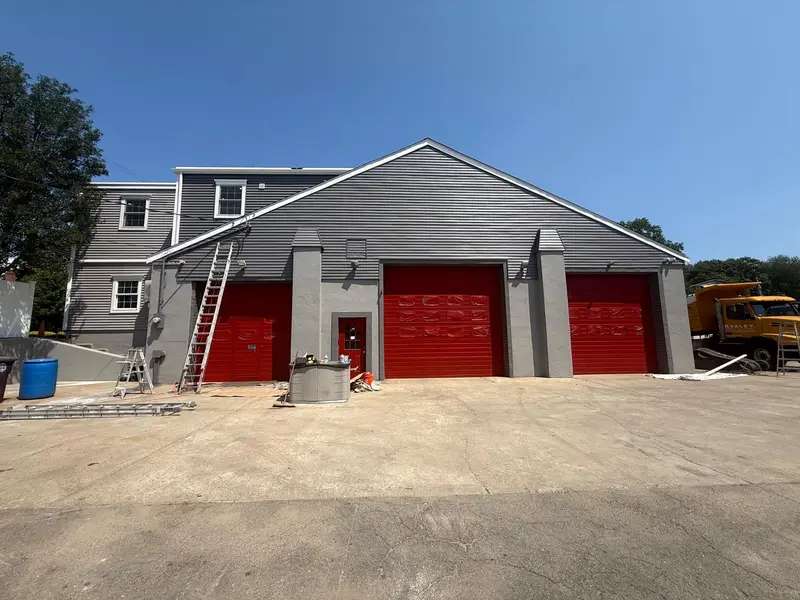
A garage building in Weymouth with white overhead doors and masonry pilasters whose paint was peeling. The doors and service doors were painted red and the pilasters refinished in gray.
See the photos →If the property is inside the Old Cambridge Historic District, yes: exterior colors there must be approved by the Historical Commission, and the color consultation is free for those properties. The city's "Learn if a property is historic" page or a call to Commission staff will confirm whether your lot is inside the boundary.
In the Mid Cambridge conservation district, work done in kind, matching existing conditions exactly, receives a Certificate of Non-Applicability. Ask Commission staff how that applies to a same-color repaint on your house before the work is scheduled.
It is the Commission's recommended approach for 19th- and early 20th-century houses: a body color, a trim color for all decorative woodwork, and a sash-and-door color used only on the movable parts of windows and doors.
Not necessarily. Sun-facing walls wear fastest, and peeling to bare wood can come from age and weathering alone. Peeling concentrated under gutters, around windows or below a bathroom points to moisture that should be fixed before repainting. See common exterior paint failures.
The EPA's lead-safe rule sets ground-covering and containment requirements for exterior work, with added measures when the work area is close to a property line. Where houses sit close together, sheeting on the ground and vertical containment keep chips and dust on your side of the lot line, and any debris that does reach a neighboring surface is cleaned up as part of the job.
AJ does not publish prices. The exterior painting cost guide lays out Massachusetts market ranges, and the Cambridge cost page covers local factors. Height, the amount of scraping and a third trim color all affect the number.
Free on-site visit and written estimate from AJ Painting, licensed and insured. Call (508) 258-4325, Monday to Saturday, 7AM to 6PM.
5.0 on Google · 35 verified reviews · Licensed & insured · Written quote in 48h