
Norwood, MA
Porch Floor, Steps & Railings in Norwood, MA
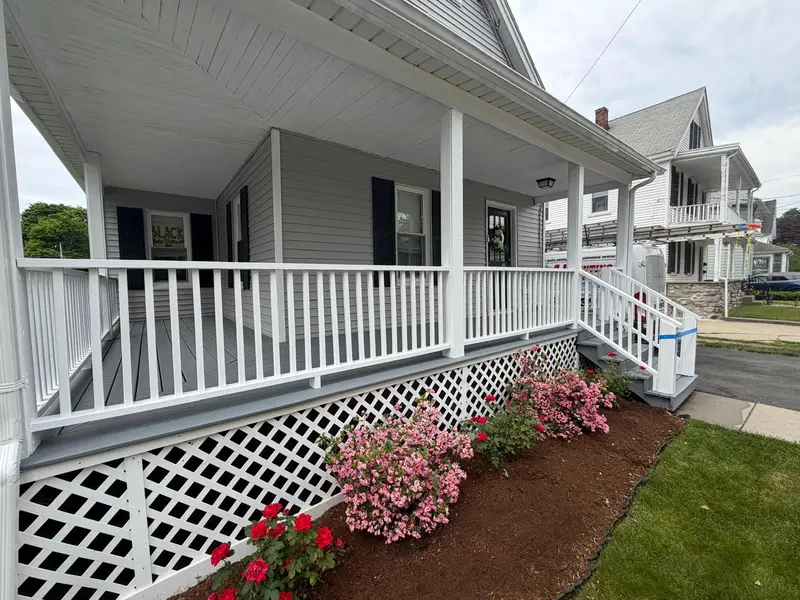
A Norwood home's front and back porches: floor boards and steps painted gray, with railings, balusters and lattice skirting in white.
See the photos →Siding, trim, doors and shutters scraped, primed and painted, with the town's Historic District Commission process sorted out before a new color goes on.
The outside of a house is where its age shows most plainly. Here the range runs from an early-18th-century saltbox on North Road, the Job Lane House, through the Colonial and Federal buildings of the town center, to a large stock of postwar homes and three decades of newer construction. Each has its own failure points, and on some streets there is also a town review to clear before changing color.
Housing from the 1950s and 1960s makes up 32.7% of units, more than any other twenty-year span in the census table. From 1990 through 2019, another 37.9% of units went up. Where a newer house is clad in a material that is not meant to be painted, the job may shrink to trim, doors and garage doors; where it has wood or fiber-cement siding, it is a full repaint like any other.
The town's Historic District and its Historic District Commission were set up by Town Meeting in 1964 under a special act. Inside that local district, an owner applies for a public hearing before making external changes, and the commission's list of covered items includes paint color, with white as the stated exception. Applications go through the Code Enforcement Department, and the town publishes Bedford Historic Guidelines for applicants.
Being on the National Register is a separate matter. The Bedford Center Historic District, listed in 1977 and enlarged in 2014, runs along Great Road between Bacon and Concord Roads with adjoining side streets, but the commission's web page does not publish the local district's boundaries, so do not assume one equals the other. If you are unsure whether ordinary repainting of your house needs a hearing, the town's advice is to contact a commission member, and it is worth doing that before choosing a color rather than after.
More than half the local housing, 54.1%, predates 1980, and federal lead rules reach every house built before 1978. Outdoors, EPA's renovation rule applies once paid work disturbs more than 20 square feet of paint. On a full repaint of an older clapboard house, scraping one wall can be enough to pass that threshold.
That means ground covering extended out from the foundation, warning signs, no open-flame burning, and collecting debris every day so paint chips do not end up in garden beds. The lead-safe painting page has the full procedure.
The common exterior paint failures guide explains why blistering, alligatoring and peeling each point to a different cause.
Exterior latex needs surface and air temperatures above the label minimum, which for most products is around 35 to 50 degrees, plus dry conditions while it cures. In eastern Massachusetts that leaves a working window from spring into fall, with cold nights and early dew narrowing it at both ends. Whether late-season work is still possible is covered in painting a house exterior in November.
If the deck needs attention too, the deck staining page for Bedford explains why the house usually goes first.
| Historic District Commission | Established 1964; paint color other than white requires a hearing in the local district (Town of Bedford, Historic District Commission) |
| Bedford Center Historic District | National Register 1977; boundary increase 2014 (Wikipedia, citing NPS NRIS and the MACRIS nomination) |
| Homes built 1950–1969 | 32.7% of housing units (U.S. Census ACS 2024 5-year, table B25034) |
| Homes built before 1980 | 54.1% of housing units (U.S. Census ACS 2024 5-year, table B25034) |
| Exterior lead-safe threshold | More than 20 sq ft of paint disturbed, pre-1978 housing (U.S. EPA, Renovation, Repair and Painting Program) |
These jobs were in other towns, not in Bedford. Each card names the town where the work was done.
A Norwood home's front and back porches: floor boards and steps painted gray, with railings, balusters and lattice skirting in white.
See the photos →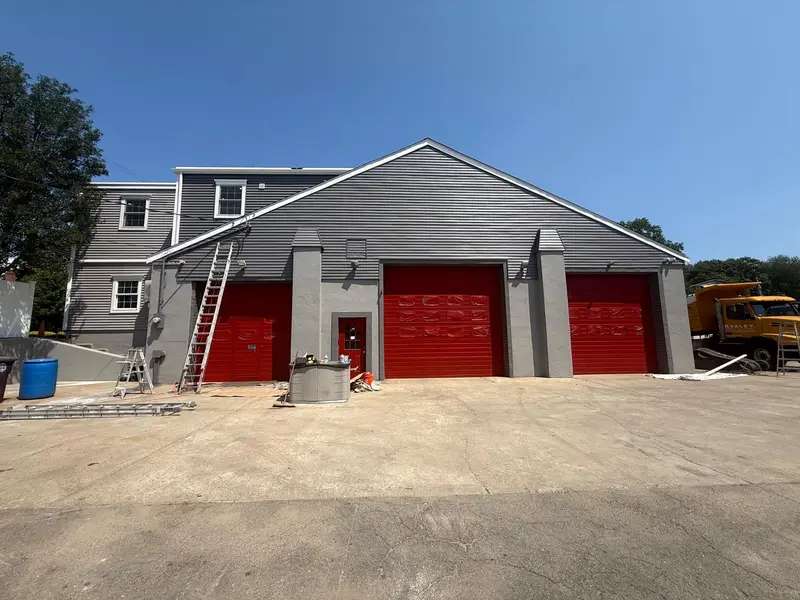
A garage building in Weymouth with white overhead doors and masonry pilasters whose paint was peeling. The doors and service doors were painted red and the pilasters refinished in gray.
See the photos →If the house is inside the local Historic District, a new color other than white needs a hearing before the Historic District Commission. Repainting can still raise questions, so the town suggests contacting a commission member if you are not sure. Being near the National Register district does not by itself tell you whether you are in the local one.
The commission's page lists paint color as a reviewed item with white as the exception. Other exterior changes, such as new trim profiles, roofing or shutters, may still need review, so check before combining a repaint with repairs.
Possibly. A house built before 1978 can have lead-based paint in its lower layers. If testing finds it and more than 20 square feet will be scraped, the work has to follow EPA lead-safe practices.
Typically the wood or composite trim, fascia, doors, shutters and garage doors. Vinyl can be painted with a vinyl-safe color, but going much darker than the original can make it warp in sun.
It depends on the product's minimum temperature and on nights staying above it while the paint cures. Late-fall work is possible on some days, but the forecast decides, not the calendar.
House size, number of stories, condition of the existing paint, carpentry and lead-safe setup all move the number. The exterior painting cost guide for Massachusetts shows market ranges; AJ Painting's figure comes in a written estimate after an on-site visit.
AJ Painting is licensed and insured. Call (508) 258-4325, Mon–Sat 7AM–6PM, to book a free on-site visit and written exterior estimate.
5.0 on Google · 35 verified reviews · Licensed & insured · Written quote in 48h