

Norwood, MA
Porch Floor, Steps & Railings in Norwood, MA
A Norwood home's front and back porches: floor boards and steps painted gray, with railings, balusters and lattice skirting in white.
See the photos →Siding, trim, porches and doors scraped, repaired and repainted with attention to the wood details on older houses and the moisture that comes with homes near the water.
The outside of a house in this town can be anything from a gable-front Greek Revival on West Main Street to a vinyl-and-trim colonial finished in the last decade. About 23.5% of housing units were built in 2000 or later, while 20.7% predate 1940. On a newer house with vinyl siding, the paintable surfaces may be limited to trim, doors, garage doors and any fiber-cement or wood siding. On the older ones, the whole envelope is wood, and the paint is what keeps water out of it.
The 2006 Freedom's Way reconnaissance report lists the styles found along Washington and Pleasant Streets as Queen Anne, Shingle and Colonial Revival, all wood-frame and built in the late 1800s and early 1900s. On West Main Street it notes modest Greek Revival houses alongside Italianate and Stick Style examples, many with bracketed door hoods, and observes that some have since been covered with siding.
Those features shape the job. Shingle-style walls take stain or paint differently from clapboard, and wood shingles that have weathered need cleaning and a primer that soaks in. Brackets, turned porch posts and scrollwork have end grain and joints where water sits, so they get hand-scraped, caulked only where a joint should be sealed, and primed on any bare wood. Where an older house has been covered in vinyl or aluminum, the original trim around windows and doors is sometimes still exposed and still needs paint.
With 53.9% of local units built before 1980, any house of that age that still has original wood siding or trim may carry paint from before the 1978 lead ban, possibly buried under newer coats. Scraping and sanding those layers releases chips and dust onto soil where children play and gardens grow. Federal RRP rules apply once paid work disturbs more than 20 square feet of lead paint outside, and they require a certified firm, ground covering, no open-flame burning and careful collection of debris. Details are on the lead-safe painting page.
A chain of ponds crosses the town from east to west. Long, Sandy and Spectacle Ponds are state-designated great ponds, and the reconnaissance report notes that most of their shoreline is lined with private homes. The Nashua River runs beside MacPherson Road. A house close to water or under heavy tree cover dries slowly after rain and morning dew, which invites mildew on north walls and shortens the life of paint on the lowest courses of siding.
For those houses, prep includes a mildewcide wash, a check of the bottom boards and sills for soft wood, and enough clearance between soil, plantings and siding. Choosing a paint with a mildew-resistant film and scheduling the work after a dry stretch both matter more here than on an open, sunny lot.
Much of the commercial center burned in 1872 and was rebuilt in brick, and many buildings in the Ayer Main Street Historic District, listed on the National Register in 1989, are masonry with Italianate and Second Empire styling. Painting there tends to mean wood storefronts, cornices, window sash and upper-floor trim rather than walls. The 2006 report also mentions a town design review process and a sign and facade grant program; ask the town whether either applies before choosing new storefront colors.
Roughly one in five housing units sits in a two- to four-unit building. A multi-family exterior means taller walls, more doors and stacked porches, plus coordinating with tenants for access and window closures. Staging it side by side lets occupied units keep using their entrances while the work moves around the building.
| Ayer Main Street Historic District | National Register, listed 1989; Italianate, Second Empire and mid-19th-century Revival styles (National Park Service NPGallery (NRIS #88000193)) |
| West Main Street houses | Gable-front Greek Revival, Italianate and Stick Style; many with bracketed door hoods (Ayer Reconnaissance Report, Freedom's Way Landscape Inventory, 2006) |
| Great ponds in town | Long, Sandy and Spectacle Ponds; most shoreline occupied by private homes (Ayer Reconnaissance Report, Freedom's Way Landscape Inventory, 2006) |
| Housing units built 2000 or later | 914 of 3,891 units (23.5%) (U.S. Census ACS 2020–2024 5-year, table B25034) |
| Historic resources surveyed | 260 structures and landscapes (2007 and 2022 surveys) (Town of Ayer, Historic Resources Surveys) |
These jobs were in other towns, not in Ayer. Each card names the town where the work was done.
A Norwood home's front and back porches: floor boards and steps painted gray, with railings, balusters and lattice skirting in white.
See the photos →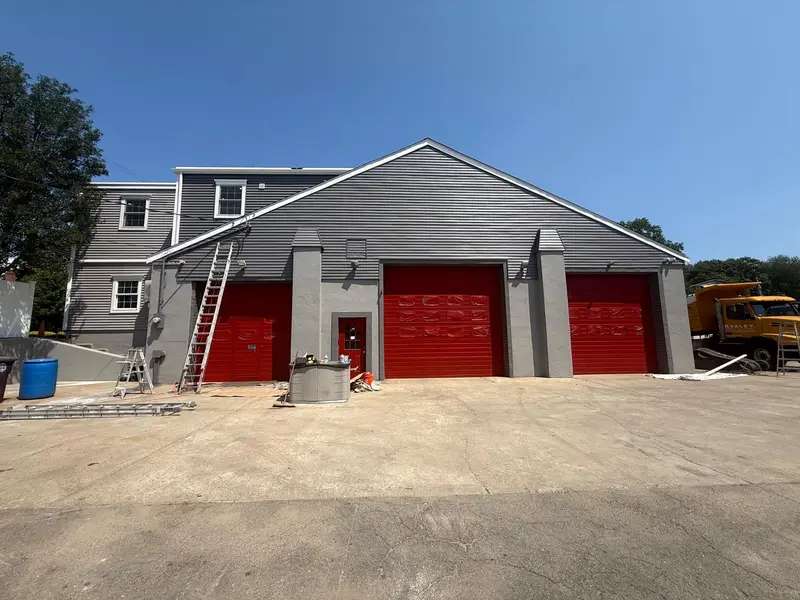
A garage building in Weymouth with white overhead doors and masonry pilasters whose paint was peeling. The doors and service doors were painted red and the pilasters refinished in gray.
See the photos →National Register listing by itself does not restrict what a private owner paints with private funds. The 2006 reconnaissance report mentions a town design review process, and its current reach is not confirmed here, so check with the town before a color change on a building in the center, especially a storefront.
The 2007 and 2022 surveys recorded 260 structures and landscapes for the Massachusetts Historical Commission database. Being surveyed documents a building; it is not the same as being in a regulated local historic district. The town can confirm whether any bylaw applies to your property.
Only if the cause is addressed too. The wall needs a mildewcide cleaning, then a primer and finish with mildew resistance. Trimming branches, pulling mulch back from the siding and keeping gutters clear help the wall dry between rains.
Yes. Exposed wood window casings, corner boards, door hoods and porch parts can be scraped, primed and painted while the vinyl is cleaned and left as is.
Most exterior paints need surface and air temperatures above a minimum, often 35 to 50°F depending on the product, through the drying period. Late spring through early fall is the usual window; the November painting article explains what changes late in the year.
Wall height, trim complexity, the amount of scraping and wood repair, and lead-safe requirements drive it. See the Massachusetts exterior painting cost guide for market figures; AJ Painting writes its estimate after a free look at the house.
Call AJ Painting at (508) 258-4325, Mon–Sat 7AM–6PM. Licensed and insured, with a free on-site visit and a written exterior estimate.
5.0 on Google · 35 verified reviews · Licensed & insured · Written quote in 48h