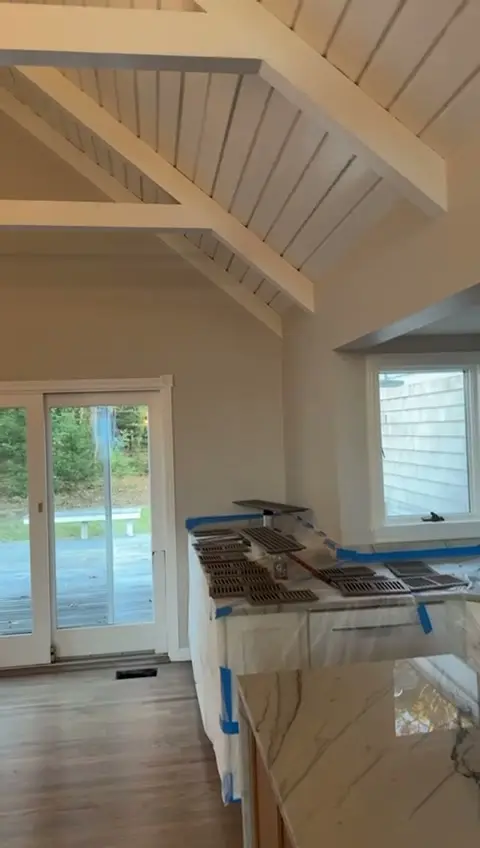
Interior painting, Ayer MAPainting inside an Ayer home starts with knowing which decade built it
Census estimates show a wide spread of ages in the local housing. About 20.7% of units were built in 1939 or earlier, 33.2% went up between 1940 and 1979, 23.5% date from 2000 or later, and the rest were built in the 1980s and 1990s. Each group asks for different prep before a brush touches the wall, so the first question on a walkthrough is when the house was built and what has been changed since.
The oldest group traces back to the railroad. The Fitchburg Railroad reached the area in 1845, the settlement around Main and Park Streets grew as Groton Junction, and the town was incorporated in 1871. A house from that stretch may have some combination of lime plaster on wood lath, tall baseboards, layered window casings and doors that have been painted many times over.
Plaster walls and ceilings in the older houses
Plaster that has survived a century tends to show it at the ceiling first: hairline cracks that follow the lath, bulges where the keys have let go, and stains from an old roof or bathroom leak. Paint does not fix any of that. Loose sections need to be reattached or cut out and patched, cracks need tape or a bonding compound so they do not telegraph back through, and water stains need a stain-blocking primer before the finish coat.
The 2006 Freedom's Way reconnaissance report describes the Pleasant Street and Washington Street area just north of the center as late 19th and early 20th century wood-frame houses in Queen Anne, Shingle and Colonial Revival styles. Interiors from those periods may still have their original stair balusters, built-in cabinets and paneled doors. Original woodwork of that age can carry many layers of old paint, so it rewards careful sanding and a trim enamel that levels out.
Lead paint and pre-1978 rooms
An estimated 2,097 of the town's 3,891 housing units, or 53.9%, were built before 1980, and lead-based paint for homes was banned in 1978. Not every older room has lead, but window sashes, stools, door jambs and stair parts are the places where friction turns old paint into dust. Testing before sanding is the only way to know.
When paid work disturbs more than six square feet of lead paint inside a pre-1978 home, the EPA Renovation, Repair and Painting rule requires a certified firm, plastic containment, no dry power sanding without HEPA collection, and a specialized cleanup and verification at the end. The lead-safe painting page walks through what that looks like day to day.
Postwar and 1970s houses
The single largest decade in the census table is 1970 to 1979, with about 478 units. Houses from that era generally have drywall rather than plaster, and the issues are different: nail pops along ceiling joists, seams that show under raking light, and dark stained or varnished trim. Painting over stained or varnished wood needs a bonding primer after a scuff sand, or the new paint can peel off in sheets.
Ceilings in that period were sometimes finished with a sprayed acoustic texture. If yours has one, it should be tested for asbestos before it is scraped or heavily wetted; painting over an intact textured ceiling is possible but adds weight and makes later removal harder.
Two- and three-family buildings
About 20% of local units sit in buildings with two to four apartments, and roughly 30.8% of occupied units are rented. For an owner of a two-family or a three-unit house, the gap between tenants can be the only window for interior painting. A washable eggshell or satin in hallways and kitchens and a flat on ceilings keeps touch-ups simple, and choosing one standard wall color across units means leftover paint is always useful. If a child under six will live in a pre-1978 unit, the Massachusetts Lead Law adds obligations for the owner beyond the painting itself.
Ayer at a glance
| Housing units built 1939 or earlier | 804 of 3,891 units (20.7%) (U.S. Census ACS 2020–2024 5-year, table B25034) |
| Housing units built before 1980 | 2,097 of 3,891 units (53.9%) (U.S. Census ACS 2020–2024 5-year, table B25034) |
| Largest single decade of construction | 1970–1979, about 478 units (12.3%) (U.S. Census ACS 2020–2024 5-year, table B25034) |
| Units in 2–4 unit buildings | 777 of 3,891 units (20.0%) (U.S. Census ACS 2020–2024 5-year, table B25024) |
| Pleasant St./Washington St. area | Late 19th–early 20th c. wood-frame Queen Anne, Shingle and Colonial Revival houses (Ayer Reconnaissance Report, Freedom's Way Landscape Inventory, 2006) |