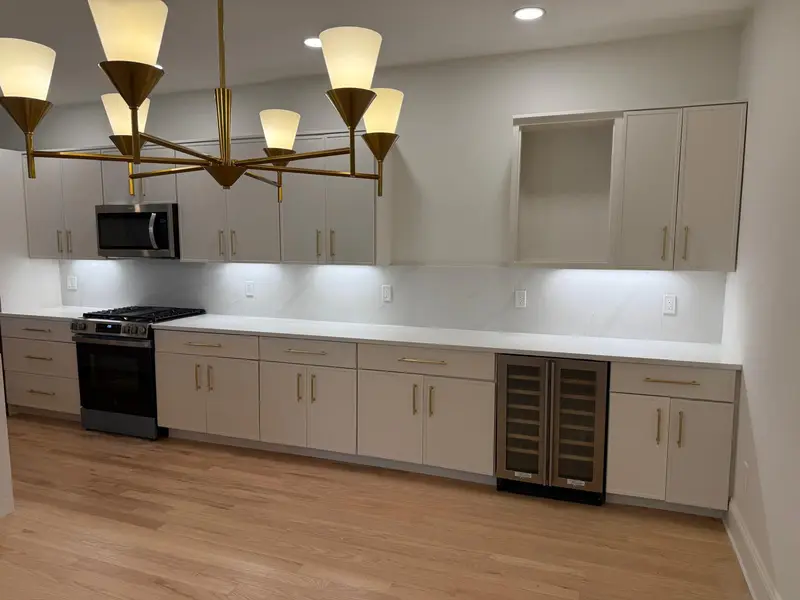
Cabinet paintingRepainting the cabinets you already have in midcentury and older kitchens
Kitchens get remodeled on their own schedule, so the age of the house does not tell you the age of the cabinets. Still, the numbers give some context. Census estimates show 289 homes in town built in the 1960s and 310 in the 1970s, with a median year built of 1968. Unless a kitchen has been remodeled, cabinets in houses like these may be original site-built or factory boxes from that era, or a replacement from a later renovation.
Whatever their age, the question is the same: are the boxes and doors sound? Solid wood or plywood boxes with doors that still close square are good candidates for paint. Swollen particleboard, delaminating veneer near the sink, or a layout you no longer want are better reasons to replace. Our refinish-or-replace guide goes through that decision in more detail.
Oak, maple, cherry and painted pine
Each wood takes paint differently. Oak has open grain that shows through enamel as a texture; if you want a smooth, furniture-like face, the grain is filled before priming. Maple and cherry are closed-grain and come out smooth with a good primer. Pine cabinets, more likely in an older or farmhouse-style kitchen, can bleed knots and sap through latex, so a shellac-based primer is used over them.
Cabinets that were painted years ago need a different approach. The old coat is checked for adhesion and, in a house built before 1978, tested for lead before any sanding. If it is sound, it is scuffed and primed; if it is lifting or lead-positive, it is removed or handled with lead-safe methods.
How a cabinet job runs
Cooking grease keeps primer from bonding, so cleaning is the first real step, not a quick wipe. After that the surfaces are sanded, dusted and primed with a bonding primer designed for cabinets. Doors and drawer fronts are numbered and finished off-site or in a protected area, which keeps spray off the countertops and lets both sides cure flat.
The cabinet boxes and face frames stay in place and are masked, primed and finished on site. A waterborne alkyd or urethane enamel gives a hard surface that resists chips and stands up to cleaning. Full cure takes longer than dry-to-touch, so doors are rehung after the finish can handle hardware and handling.
- Remove doors, drawers and hardware; label every piece
- Degrease, sand and fill dents or open oak grain
- Prime with a cabinet-grade bonding primer
- Spray or brush two enamel coats, then reinstall and adjust hinges
Kitchens in antique houses
Very old houses are part of the picture here. A Town of Sherborn preservation document counts 77 old houses on the National Register and notes that many houses from the 1700s and early 1800s survive. In a house that old, the kitchen you see today is likely much newer than the frame, and it may have built-in cupboards, beadboard or painted pine that are worth keeping.
Built-ins and older painted cabinetry that cannot be removed can be brushed rather than sprayed, which also keeps the hand-painted look of the room. The Sherborn Center historic district's 2007 guidelines list interior features not visible from a public way as an exception to review, so kitchen work there needs no Commission approval.
Getting started
AJ Painting is based in Ashland, licensed and insured. The on-site visit is free, and you get a written estimate that lists what is included, such as doors, boxes, interiors, crown molding and hardware. If the rest of the kitchen walls or nearby rooms need painting too, see interior painting in Sherborn.
Sherborn at a glance