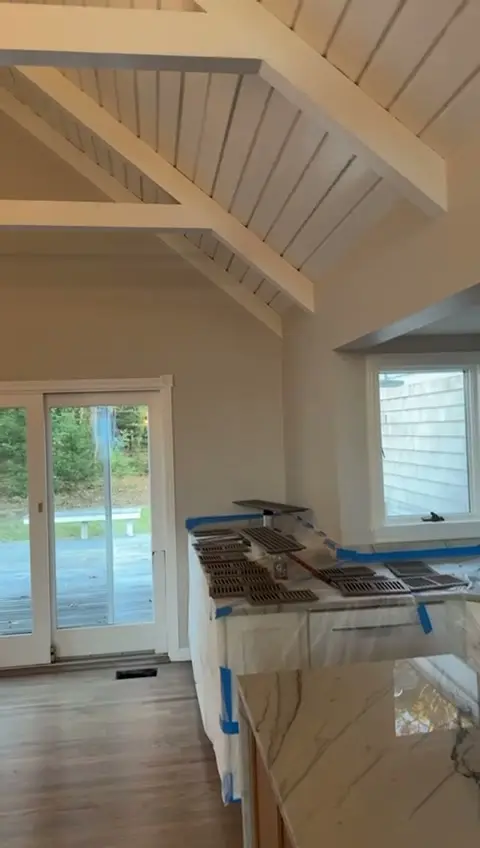
Interior paintingPainting rooms in colonial-era houses and midcentury homes alike
What an interior job involves in this town depends heavily on when the house went up. Roughly one home in five here dates to 1939 or earlier, according to the Census, and a town history notes that six or more houses still contain portions from the late 1600s. More than half the housing stock, 815 units, was built from 1950 through 1979, with the 1970s the largest single-decade estimate at 310 units (±106).
A house from before World War II was most likely finished with plaster on wood or metal lath, and its trim may have been painted and repainted for generations. Houses from the 1960s and 1970s were more often built with drywall, and their interiors tend to be about wear: scuffed hallways, nail pops, yellowed ceilings and trim that no longer matches the walls.
Plaster walls and ceilings
Old plaster cracks as a house settles and as seasons change the moisture in the framing. Hairline cracks can be taped and skimmed; wider cracks, loose patches and ceilings that sag away from the lath need to be reattached with plaster washers or cut back and patched before paint. Skipping that step means the crack comes back through the new finish within a season or two.
Plaster is also more absorbent than drywall where it has been patched, so repairs get a primer before the finish coats to keep the sheen even. On ceilings, a flat finish hides the waviness that is normal in hand-troweled plaster.
Lead in older trim, doors and windows
Of the town's 1,588 housing units, 1,157 were built in 1979 or earlier, before or right around the federal ban on lead in residential paint. Where lead paint is present indoors, the risk concentrates on friction and impact surfaces: window sashes and sills, doors and jambs, stair treads, and baseboards that get kicked.
When those surfaces are sanded or scraped, the dust is the hazard, not the intact paint. Work in pre-1978 rooms follows lead-safe practices, with plastic sheeting, HEPA vacuums, wet cleanup and no dry sanding, so the room is clean when furniture goes back.
Trim from many eras in one house
The Massachusetts Historical Commission's 1980 town survey names the central-chimney two-story house as the dominant colonial-era type here, the two-story rear-wall-chimney plan as the most widely built Federal-period type, and side-hall Greek Revival and Italianate houses as the most numerous from 1830 to 1870. A house that has been expanded over two or three centuries can have trim styles, wood species and paint types that change from one room to the next.
Old oil-based enamel on trim will not hold a latex coat without preparation. Each surface is tested, deglossed and primed with a bonding primer where needed, then finished in a durable waterborne enamel. If you want help with sheen choices, see our interior paint finish comparison.
- Move and cover furniture; protect wide-board and hardwood floors
- Repair plaster cracks and loose areas, then prime patches
- Test old trim for oil-based paint and prime for adhesion
- Two finish coats on walls, ceilings and trim, with daily cleanup
Scheduling inside work
Interior painting does not depend on outdoor weather, so it can be scheduled in any month. With windows closed, low-odor waterborne paints and fans keep rooms usable; our post on painting with the windows shut explains how. AJ Painting is based in Ashland, licensed and insured, and the visit and written estimate are free. For siding and trim outside, see exterior painting in Sherborn.
Sherborn at a glance