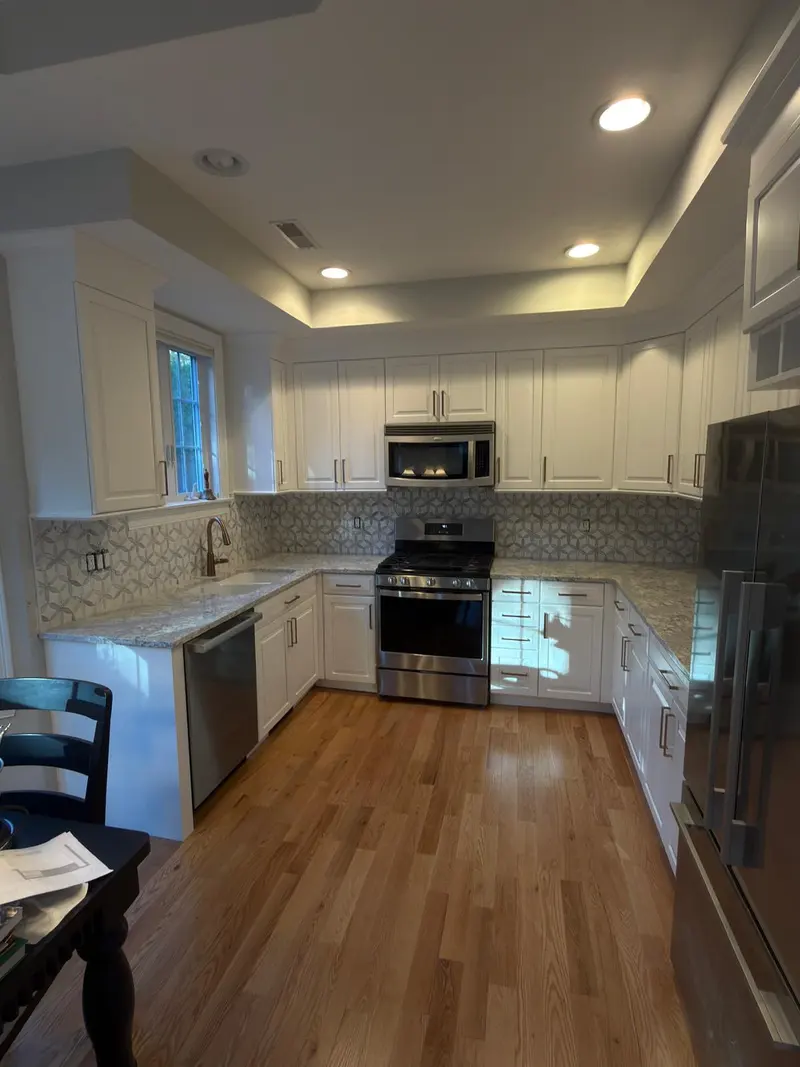
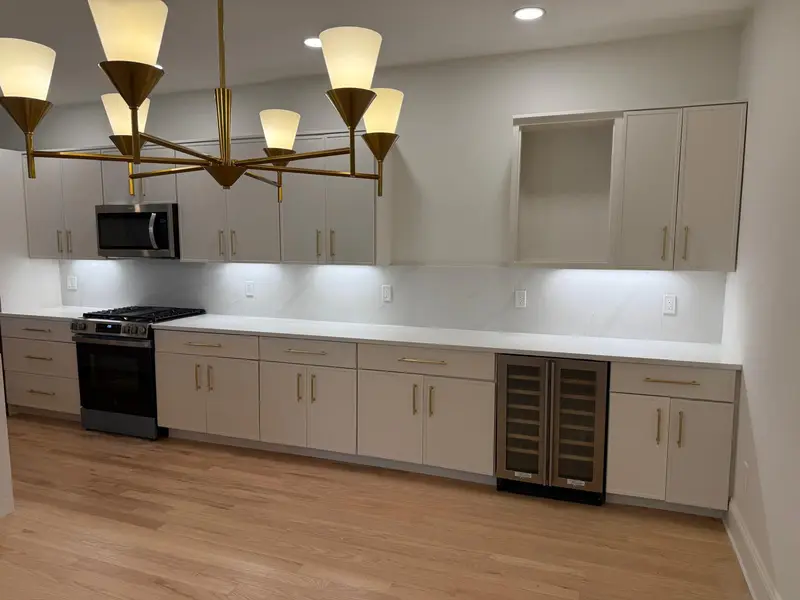
Cabinet painting, MillisRepainting Millis kitchen cabinets instead of tearing them out
The Census estimates the median value of an owner-occupied home in Millis at $603,500, and 83.2% of occupied homes are owner-occupied. If you plan to stay and the kitchen looks dated, the real question is whether solid boxes deserve a new finish or the whole kitchen should be replaced.
When the boxes are square, the doors are solid wood or good-quality MDF, and the layout still works, painting keeps the existing cabinetry and changes how the room reads. Our guide to refinishing vs. replacing kitchen cabinets lays out the decision in more depth.
Kitchens by decade
The town's housing is spread across the decades, and the cabinets inside reflect when a kitchen was last redone, not just when the house was built. Census counts give a sense of the range, and each era brings its own cabinet questions:
- 1950s and 1960s (1,014 units): a kitchen original to these years may have site-built painted pine or birch cabinets carrying many coats of old enamel
- 1970s and 1980s (1,171 units): stained oak with raised-panel or cathedral doors and an oil or lacquer topcoat was a common look in these decades
- 2010 and later (371 units): factory-finished maple, MDF or thermofoil doors, some of which take paint well and some of which do not
Prep is most of the job
Kitchen cabinets carry grease, hand oils and cleaning residue that stop paint from bonding. A proper job starts with a degreaser, then a scuff sand, then a bonding or shellac-based primer, which also blocks the tannin bleed that otherwise turns white paint yellow over oak. The open grain of oak can be filled first for a smooth look, or left to show through the paint.
Doors and drawer fronts are removed and labeled, hinges are bagged, and the boxes are masked in place. A waterborne alkyd or urethane-modified enamel cures harder than wall paint and resists chipping around handles. Full cure takes longer than dry-to-touch, so new cabinets should be treated gently for a couple of weeks.
Older paint and lead
Of the 3,471 housing units in town, 2,103, or 60.6%, were built before 1980. Painted cabinets in a pre-1978 home may have lead in the lower layers, and paid work that sands or scrapes them falls under the EPA renovation rule, which Massachusetts runs as an EPA-authorized state program. That means a certified firm, containment, HEPA vacuums and no open-flame burning or uncontrolled power sanding. See our lead-safe painting page for how that work is set up.
Stained cabinets from later decades are a different story: their clear finish isn't usually the concern, but walls and trim around them in an older house may be.
Beyond the kitchen
Bathroom vanities, built-in hutches and laundry cabinets can be done at the same time with the same finish. Bungalow-era built-ins deserve a second look before painting. The National Register nomination for the Millis Center Historic District describes bungalows going up there as infill in the 1910s through the 1930s, and an original stained built-in from that period may be worth keeping as it is.
If walls and ceilings are on the list too, see interior painting in Millis, and the post on our cabinet painting process walks through each step.
Millis at a glance
| Median owner-occupied home value | $603,500 (±$30,556) (U.S. Census ACS 2020–2024 5-year, table B25077) |
| Owner-occupied homes | 83.2% of occupied units (2,754 of 3,309) (U.S. Census ACS 2020–2024 5-year, table B25003) |
| Units built 1950–1969 | 1,014 units (568 in the 1950s, 446 in the 1960s) (U.S. Census ACS 2020–2024 5-year, table B25034) |
| Units built 1970–1989 | 1,171 units (567 in the 1970s, 604 in the 1980s) (U.S. Census ACS 2020–2024 5-year, table B25034) |
| Units built 2010 or later | 371 units (10.7%) (U.S. Census ACS 2020–2024 5-year, table B25034) |
| Bungalow infill in Millis Center | Bungalows built as infill on subdivided lots, 1910s to 1930s (NRHP nomination, Millis Center Historic District, Section 7 (NPS)) |