
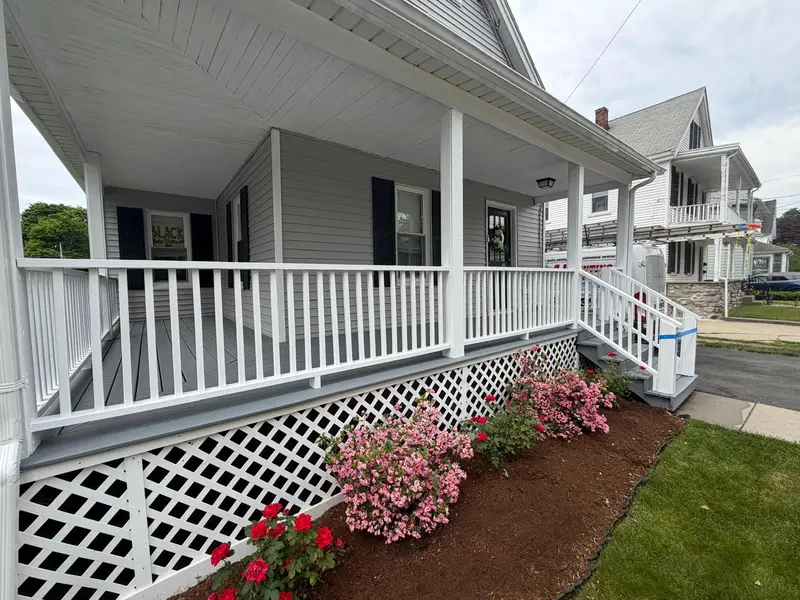
Norwood, MA
Porch Floor, Steps & Railings in Norwood, MA
A Norwood home's front and back porches: floor boards and steps painted gray, with railings, balusters and lattice skirting in white.
See the photos →Cleaning, board repair and staining or painting for decks, porches, railings and stairs in a town with heavy tree canopy and a lot of wetland.
Water is the main enemy of a deck finish, and Millis has a lot of it close by. A 2019 climate-resilience report prepared for the town by the Metropolitan Area Planning Council says the Charles River makes up one-third of the town boundary and that water bodies and wetlands cover 28% of its area.
That doesn't mean every yard is wet, but a deck built low over damp or poorly drained ground dries slowly from underneath, and that moisture works its way into the boards, the stain and the framing.
The same report puts tree canopy at nearly 60% of the town. Under a canopy, deck boards stay damp after rain and dew, collect leaves and pollen in the gaps, and grow mildew and algae that make them slick.
A few habits do more than any stain to protect a shaded deck: blowing out the gaps between boards each fall, keeping planters and mats off the surface so wood can dry, and trimming limbs to let sun reach the floor for part of the day. When it's time to recoat, a cleaner that kills mildew and a stain with a mildewcide are worth specifying.
Census figures show 67.8% of the town's housing units are single-family detached and another 10.2% are single-family attached. If your home is attached and part of an association, check the rules on deck colors and who maintains the structure before choosing a product.
A penetrating semi-transparent stain wears away slowly and can be refreshed with a cleaning and a new coat. Solid stain and paint form a film that covers worn or mismatched wood, but water trapped below a film on a damp deck pushes it off as peeling. On a low, shaded deck, a penetrating finish on the walking surface and a solid color on rails and balusters is a combination worth considering. Our paint vs. stain comparison goes through the trade-offs.
On a house built before 1978, a painted porch floor or railing may have lead in the older coats. Scraping or sanding it is regulated work; see our lead-safe painting page.
Early spring boards are often still saturated from snowmelt and rain, so late spring through early fall, after a stretch of dry days, is a better target for staining. Stain labels list a minimum temperature and a rain-free period after application; both matter more than the calendar date. The blog post on deck stain through a New England winter covers how finishes wear over the cold months, and exterior painting in Millis covers the house itself.
| Charles River on the town line | About one-third of the town boundary (MAPC, Millis Community Resilience Building Workshop Summary of Findings (MVP program), January 2019) |
| Water bodies and wetlands | 28% of the town's area (MAPC, Millis Community Resilience Building Workshop Summary of Findings (MVP program), January 2019) |
| Tree canopy | Nearly 60% of the town (MAPC, Millis Community Resilience Building Workshop Summary of Findings (MVP program), January 2019) |
| Single-family homes | 67.8% detached (2,355 units); 10.2% attached (354 units) (U.S. Census ACS 2020–2024 5-year, table B25024) |
These jobs were in other towns, not in Millis. Each card names the town where the work was done.
A Norwood home's front and back porches: floor boards and steps painted gray, with railings, balusters and lattice skirting in white.
See the photos →It can, but the finish will fail faster if the boards never dry from below. Clearing debris and vegetation under the deck, improving airflow at the skirting and choosing a penetrating stain instead of a film-forming one all help. Rotted joists or boards should be repaired before any coating.
Not necessarily. The green is mildew or algae, and a proper cleaning may be all the deck needs that year. If the stain has also faded or worn through on the walking paths, clean first, let the wood dry, and then recoat with a mildew-resistant product.
Only once the wood has dried out and temperatures meet the stain's label minimum. In a wet spring, boards can stay too damp for weeks. A moisture meter or a simple water-drop test tells whether the wood will accept stain.
Stain needs bare wood to soak into, so switching means removing all of the paint. On a porch from before 1978 that's lead-regulated work, and tongue-and-groove porch boards are often better served by stripping only loose paint and recoating with porch enamel.
The number of railings, balusters and stairs, the condition of the boards, and whether an old film has to be stripped matter more than the deck's square footage. The deck staining cost guide explains Massachusetts market pricing, and a free visit gets you a written estimate.
If the home belongs to a condominium or homeowners association, the deck may be governed by its rules on colors and maintenance responsibilities. Check the documents or ask the property manager before ordering stain.
AJ Painting is licensed and insured and based in Ashland. Call (508) 258-4325, Monday to Saturday, 7AM to 6PM, for a free on-site visit and a written estimate.
5.0 on Google · 35 verified reviews · Licensed & insured · Written quote in 48h