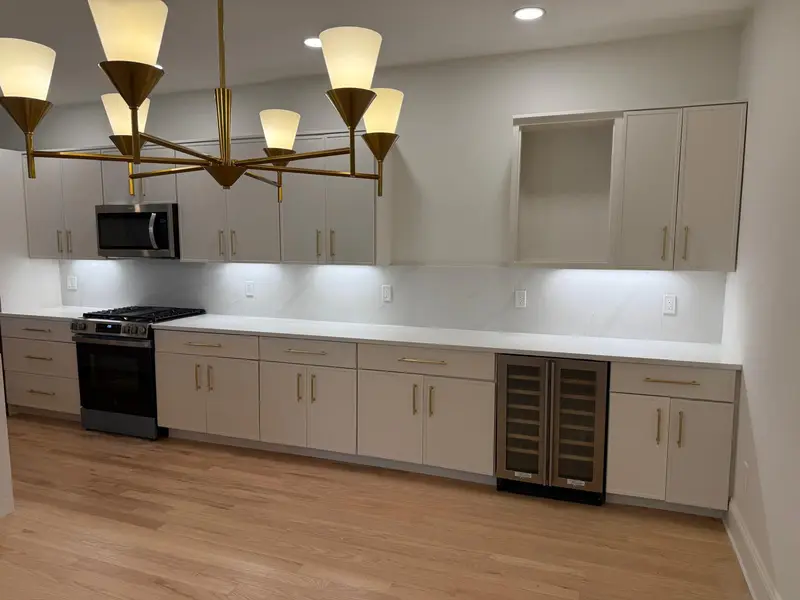
Cabinet painting, Hudson MAWhich Hudson kitchens are good candidates for painted cabinets
The town's housing stock has two large building waves that matter for cabinets. The 1960s produced 1,649 units, more than any other single decade in the Census table, and building stayed busy through the 1980s, which added another 1,246. A kitchen from either era that still has its original boxes may have solid-wood or veneer doors in stained oak, pine or maple. Wood like that is a reasonable base for paint when the boxes are square and the doors are not delaminating.
A newer group matters too. About one unit in five (20.8%) was built in 2000 or later, and those kitchens may have painted or thermofoil doors from the factory. Factory finishes can be repainted, but each needs a different primer, and peeling thermofoil cannot be painted at all.
Refinish or replace?
Painting makes sense when the layout works, the boxes are solid and the problem is the color or a worn finish. Replacement makes more sense when drawers are failing, the doors are warped, the boxes have water damage under the sink, or you want to move the sink or range anyway. The estimate visit is the time to open drawers, check hinges and look under the sink for exactly those problems.
Our refinish vs. replace guide lays out the trade-offs in more detail, and cabinet painting vs. replacement covers the questions to ask before deciding.
What a durable cabinet finish takes
Cabinets get grabbed, splashed and wiped every day, so the coating has to be harder than wall paint. A proper job goes roughly in this order:
- Doors and drawer fronts removed and labeled; hinges and pulls bagged by location
- Grease removed with a degreaser, because primer and enamel will not bond to cooking film
- Scuff-sanding and a bonding or stain-blocking primer, which matters on oak, where tannins and open grain show through
- Grain filler on oak if you want a smooth, furniture-like look instead of visible texture
- Two coats of a cabinet-grade enamel, sprayed or finely brushed, with full cure time before heavy use
Built-ins and cabinets in older houses
Close to a quarter of local units (23.4%) were built in 1939 or earlier, and 60% before 1980. In houses that old, original pantry cupboards, china cabinets and painted kitchen cabinets may carry lead in their earlier coats. Sanding door edges and face frames is exactly the kind of work the EPA's lead rule targets: paid work disturbing more than six square feet of paint per room in a pre-1978 home has to follow lead-safe practices, and our lead-safe painting page explains them.
An original built-in can be repainted and kept even when the main kitchen around it is replaced. If yours is in the downtown district, note that interior work is outside the historic commission's review, so cabinet colors are entirely your choice.
Planning around a working kitchen
Expect to live with doors off for several days while they are primed, coated and cured off site or in a protected area. Boxes and face frames are painted in place, so plan for the kitchen to be masked and partly unusable for part of that time. Hardware is a good moment to update; new pulls with different hole spacing mean filling and redrilling before paint, not after.
Cabinet painting is weather-independent, so it fits anywhere on the calendar. See how cabinet painting works step by step for the full sequence.
Hudson at a glance
| Units built in the 1960s | 1,649 (18.6%), the largest single decade (U.S. Census ACS 2020–2024 5-year, table B25034) |
| Units built in the 1980s | 1,246 (U.S. Census ACS 2020–2024 5-year, table B25034) |
| Units built 2000 or later | 20.8% (1,843 of 8,858) (U.S. Census ACS 2020–2024 5-year, table B25034) |
| Units built 1939 or earlier | 23.4% (2,070 of 8,858) (U.S. Census ACS 2020–2024 5-year, table B25034) |
| Lead-safe threshold indoors | More than 6 sq ft of paint disturbed per room, pre-1978 housing (U.S. EPA, Renovation, Repair and Painting Program) |