
Norwood, MA
Porch Floor, Steps & Railings in Norwood, MA
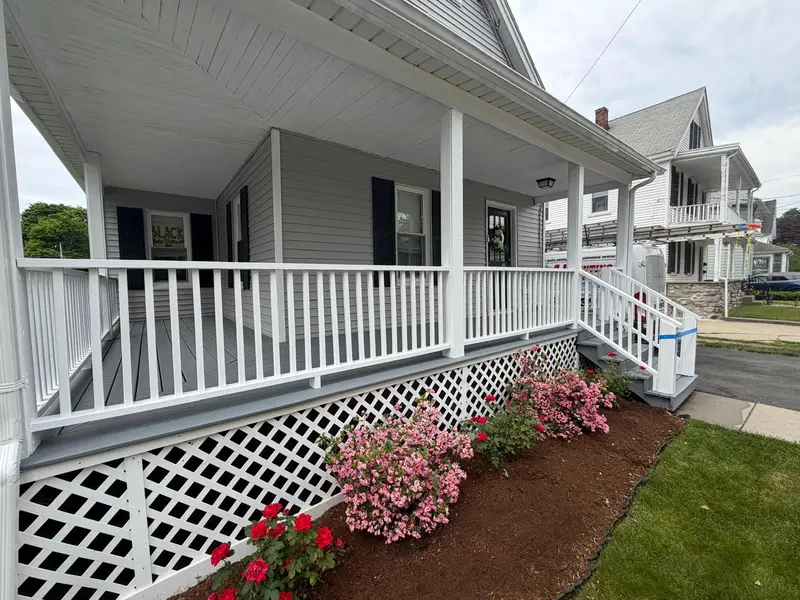
A Norwood home's front and back porches: floor boards and steps painted gray, with railings, balusters and lattice skirting in white.
See the photos →Cleaning, repairing and staining or painting decks, porches and railings at Hudson homes, with the coating chosen for the wood and the exposure of your yard.
A deck coating has to cope with standing snow, foot traffic, direct sun on the boards and water sitting in every seam. The coating that works depends less on the town than on your particular lot, the species of wood, and what is already on the boards.
Detached single-family homes make up 53.8% of local housing units, with another 7.1% in attached, townhouse-style buildings. Attached units can share a railing line or deck structure with the neighbor next door, so color and timing may need to be agreed with that owner, or with an association if there is one.
The Assabet River runs through most of the town, and Lake Boon sits on the line with Stow. A deck on a lot facing open water may see full sun and wind for much of the day, which fades pigment and dries out the top of the boards. A deck tucked under trees on the north side of a house stays damp longer after rain and collects leaves and pollen, conditions where mildew grows and film-forming coatings tend to peel.
Neither situation is a reason to skip a coating. They are reasons to pick the right one, and to check the boards for soft spots near the house, at stair stringers and around posts, where water collects first. Rotted boards should be replaced before anything is applied, because no stain will hold on wood that is breaking down.
Whatever is already on the deck limits the choice. You cannot put a penetrating stain over an old solid stain or paint without stripping first. Our paint vs. stain comparison goes deeper on which coating fits which deck, and deck stain in a New England winter explains how the freeze-thaw cycle affects each.
A deck coating fails from the bottom up when it goes on over gray, weathered fibers, dirt or mildew. A proper job means cleaning with a deck cleaner, a brightener on pressure-treated or cedar boards, sanding raised grain and loose fibers, and letting the wood dry fully before staining. New pressure-treated lumber generally needs to dry out before it will absorb stain; a sprinkle test, where water beads up or soaks in, shows when it is ready.
On older porches attached to houses built before 1978, the floor and railings may have been painted with lead-based paint decades ago. The EPA rule applies to paid exterior work disturbing more than 20 square feet of that paint, so scraping an old porch floor calls for lead-safe methods; see our lead-safe painting page.
Stain needs dry wood, no rain in the forecast for the cure period, and temperatures within the label range, so spring through early fall is the realistic window here. Avoid staining in direct midday sun on a hot day, which dries the product before it soaks in. If you are also repainting the house, the exterior painting page covers coordinating both.
| Single-family detached homes | 53.8% of units (4,769 of 8,858) (U.S. Census ACS 2020–2024 5-year, table B25024) |
| Single-family attached units | 7.1% (633 units) (U.S. Census ACS 2020–2024 5-year, table B25024) |
| Lake Boon | On the Hudson–Stow line; its commission, created by the State Legislature in 1941, has one Hudson member and two from Stow (Town of Stow, Lake Boon Commission) |
| Exterior lead-safe threshold | More than 20 sq ft of paint disturbed outside, pre-1978 housing (U.S. EPA, Renovation, Repair and Painting Program) |
These jobs were in other towns, not in Hudson. Each card names the town where the work was done.
A Norwood home's front and back porches: floor boards and steps painted gray, with railings, balusters and lattice skirting in white.
See the photos →Clean off the mildew first with a deck cleaner, let the boards dry thoroughly, and lean toward a penetrating stain with a mildewcide rather than a thick film. Trimming back branches to let in air and light helps any coating last longer.
Sun breaks down the pigment and the top layer of wood fibers. Semi-transparent stains with more pigment, or a solid stain on railings and vertical parts, hold color longer. Expect to renew sun-facing boards more often than shaded ones.
Not with a penetrating stain. Paint or solid stain has to be stripped or sanded off first, or you recoat with another solid-color or paint product. A test patch at the estimate shows how much old coating remains.
When the wood absorbs water instead of beading it. That can take weeks or months depending on how wet the lumber was and the weather; check the lumber supplier's and stain maker's guidance.
Any board that is soft, split through or cupping badly should be replaced, along with loose nails or screws reset. Stain only protects wood that is still sound.
Size, railings and stairs, the amount of stripping, and board repairs set the price. Our Massachusetts deck staining cost guide shows market ranges; AJ Painting provides a written estimate after a free on-site visit.
Licensed and insured. Call (508) 258-4325 for a free on-site visit and written estimate, Mon–Sat 7AM–6PM.
5.0 on Google · 35 verified reviews · Licensed & insured · Written quote in 48h