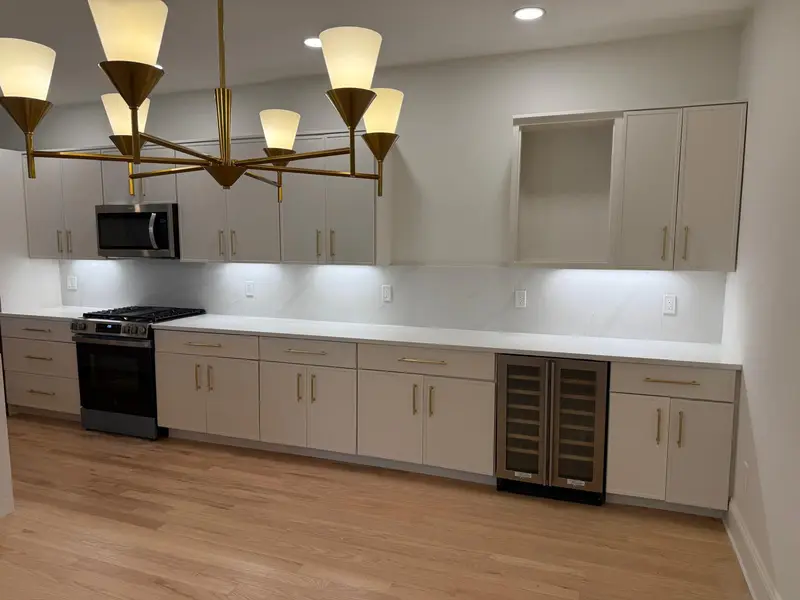
Cabinet paintingRepainting cabinets in Charlton kitchens built from the 1980s on
More than half of Charlton's homes, 2,866 of 5,197 units or 55.1%, were built between 1980 and 2009, and the 1980s alone account for 1,136 of them in the Census Bureau's 2020–2024 estimates. Unless a kitchen in one of those houses has been remodeled, its cabinets date from those same three decades.
Age alone does not decide whether cabinets are worth painting; construction does. Face frames and doors of solid wood or MDF take paint well. Particleboard boxes can be painted if they are dry and intact, but swelling or delamination under the sink or beside the dishwasher points to repairing or replacing that one unit first.
What your cabinets are made of
Open a door and look at the edge and the back. The material sets the primer, the sanding and how smooth the result can be.
- Oak: deep, open grain that shows through paint. For a smooth, furniture-like face, the pores must be filled with grain filler or built up with a high-build primer; if you like some texture, that step can be skipped
- Maple, birch or cherry: closed grain that paints smoothly, though a hard factory lacquer needs a thorough scuff-sand and a bonding primer
- MDF doors: flat and stable; cut edges soak up primer and need an extra coat to seal
- Thermofoil or laminate: vinyl or plastic skins over a core. Paint holds only over a specialty primer, and foil that is already bubbling or peeling cannot be painted over
Paint, reface or replace
Painting keeps the existing boxes, doors and layout and changes color and sheen. Refacing adds new doors and drawer fronts and veneers the frames. Replacement is the only one of the three that fixes a layout that does not work, a sagging box or water damage. If your cabinets are square and solid and you are happy with where they sit, painting is the least disruptive option; painting versus replacement compares the trade-offs in more detail.
Hardware is part of the decision. New pulls with a different hole spacing mean filling and redrilling the old holes before priming, which is easier to do during a paint job than afterward.
Built-ins in older houses
At the other end of the age range, 7.7% of the town's units date from 1939 or earlier, and the Massachusetts Historical Commission recorded center-chimney houses from the 1700s as the main Colonial-era survivors. Kitchens in houses that old may have been redone more than once, but a built-in cupboard, pantry shelving or painted trim near the kitchen can still carry layers from before 1978.
The Census puts 40.0% of the town's housing before 1980. If your house was built before 1978, have old painted built-ins tested before anyone sands them. The lead-safe painting page covers how that work is contained in a lived-in kitchen.
How the work goes
Kitchen cabinets collect cooking grease that paint will not stick to, so thorough cleaning has a large effect on how long the finish lasts. Details are in our cabinet painting process.
- Remove and label doors, drawer fronts and hardware
- Degrease every surface, then scuff-sand and vacuum
- Apply a bonding primer; fill oak grain if a smooth face is wanted
- Lay on two coats of cabinet-grade enamel and let it cure before rehanging
Estimating the job
Door and drawer count, whether interiors are painted, grain filling, repairs and the number of colors set the scope. The cabinet painting cost guide explains each factor with Massachusetts market data. AJ Painting Services, licensed and insured and based in Ashland, prices your kitchen in a written estimate after a free on-site visit.
Charlton at a glance
| Housing units built 1980–2009 | 55.1% (2,866 of 5,197 units) (U.S. Census ACS 2020–2024 5-year, table B25034) |
| Housing units built 1980–1989 | 1,136 (±283), 21.9% of units (U.S. Census ACS 2020–2024 5-year, table B25034) |
| Housing units built before 1980 | 40.0% (2,080 of 5,197 units) (U.S. Census ACS 2020–2024 5-year, table B25034) |
| Owner-occupied homes | 84.9% of occupied units (4,251 of 5,007) (U.S. Census ACS 2020–2024 5-year, table B25003) |