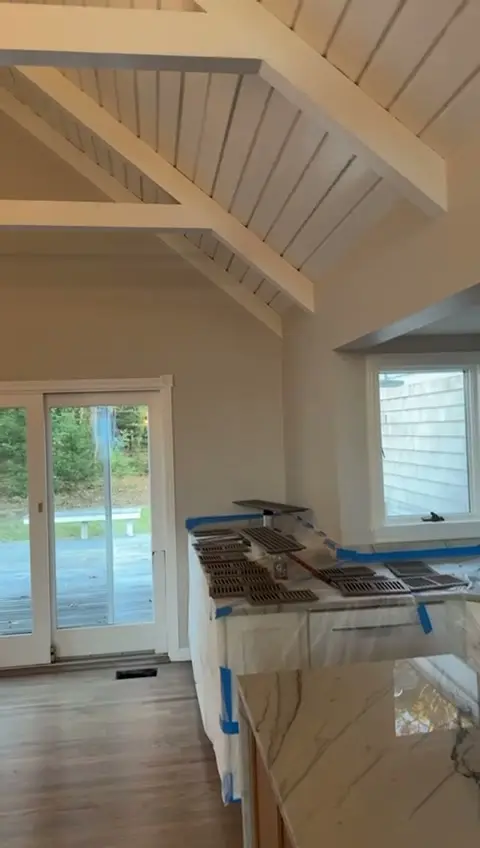
Interior paintingPainting inside Charlton houses, from early plaster to 1980s drywall
Half of Charlton's housing was built in 1985 or later, by the median construction year in the Census Bureau's 2020–2024 American Community Survey. Units built from 1980 through 2009 make up 55.1% of the town's 5,197 homes, and only 4.8% went up in 2010 or later. Houses from those decades were typically finished in drywall, which by now has stood for somewhere between about seventeen and forty-six years.
Drywall that old can show nail pops, hairline cracks along taped corners and over doorways, and dents in baseboard and casing. Those repairs come before any color, because a fresh flat or eggshell finish makes every bump and seam easier to see under a window or a ceiling light.
The older end: plaster and early house plans
The town also has a much older layer. The Massachusetts Historical Commission's 1984 reconnaissance survey found center-chimney houses from the middle decades of the 1700s to be the main Colonial-era survivors, and it recorded a 1726 one-story "three-quarter house" as the earliest standing structure. The same report describes house building between 1830 and 1940 as scattered, with no significant development observed from 1915 to 1940. The Census counts 398 units (7.7%, with a margin of error of ±181) built in 1939 or earlier.
Walls in houses of that age are typically plaster over wood lath unless they have been re-sheathed. Plaster cracks get cut open and filled, loose sections are pulled back to the lath with plaster washers, and every patch is primed so it does not flash through the finish coat. If a ceiling still carries old calcimine or distemper paint, it has to be washed off or sealed with a specialty primer, since latex will not hold to it.
Lead dust is an indoor problem first
By the ACS count, 40.0% of the town's units (2,080) were built before 1980. The Census groups construction by decade, so that total includes some homes from 1978 and 1979, after the federal ban on lead paint for residential use; the construction year of your own house is what matters. In a pre-1978 home, the indoor hazard is concentrated on friction and impact surfaces such as window sashes, sills, door jambs and stair treads, and from dust raised when old layers are sanded or scraped.
The EPA's Renovation, Repair and Painting rule sets containment, work-practice and cleanup requirements for paid work that disturbs those layers. Our lead-safe painting page explains what that means room by room.
Ceilings, trim and sheen
Test a hidden corner of any sprayed-texture ceiling before rolling it. Some textures soften when wet and come off on the roller, and textures applied before the 1980s may contain asbestos, so those should be tested before any scraping.
Trim and doors take a beating from hands, vacuums and pets, which is why a satin or semi-gloss enamel outlasts wall paint there. To find out whether existing trim is oil-based, rub a small spot with denatured alcohol: latex softens and smears, oil does not. Oil-painted trim needs cleaning, a scuff sand and a bonding primer before a waterborne enamel goes on.
- Move furniture to the room's center and cover floors and contents
- Fill nail pops, re-tape cracked seams, and repair plaster cracks
- Spot-prime patches, or prime whole walls when sheen is uneven
- Cut in and roll two finish coats; enamel on trim and doors
Scheduling and the estimate
Indoor work is not tied to the outdoor season, though painting with the windows shut in January needs a ventilation plan; see painting with closed windows. Room count, ceiling height, wall condition, trim detail and whether lead-safe practices apply all change the scope.
The Massachusetts interior painting cost guide walks through those factors using statewide market data. For your rooms, AJ Painting Services, based in Ashland and licensed and insured, does a free on-site visit and puts the estimate in writing.
Charlton at a glance
| Median year housing was built | 1985 (±3) (U.S. Census ACS 2020–2024 5-year, table B25035) |
| Housing units built 1980–2009 | 55.1% (2,866 of 5,197 units) (U.S. Census ACS 2020–2024 5-year, table B25034) |
| Housing units built before 1980 | 40.0% (2,080 of 5,197 units) (U.S. Census ACS 2020–2024 5-year, table B25034) |
| Housing units built 1939 or earlier | 7.7% (398 ±181 of 5,197 units) (U.S. Census ACS 2020–2024 5-year, table B25034) |
| Earliest recorded standing structure | A 1726 one-story "three-quarter house"; center-chimney plans predominate among Colonial survivals (Massachusetts Historical Commission, Reconnaissance Survey Town Report: Charlton (1984)) |