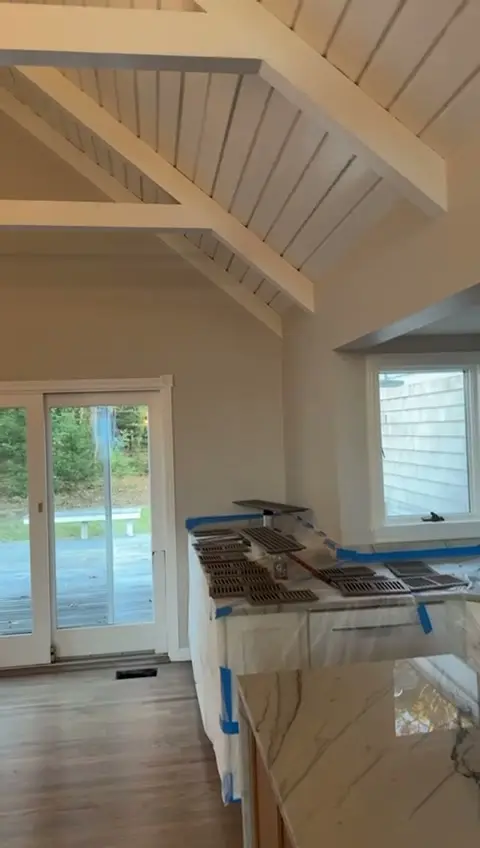
Interior paintingPainting the inside of a house built in the town's 1970s and 1980s boom, or a century before it
Census estimates put the median construction year of Pepperell's housing at 1981. That number hides two very different groups of houses. The 1980s are the largest decade still standing, with 1,067 units, and the 1970s come second with 803. At the other end, 675 units, or 15.1%, date from 1939 or earlier. The 1940s barely register: the Census estimate for that decade is just 19 units, with a margin of error larger than the count.
Those groups need different preparation before any color goes on. Drywall from the 1980s may need patching at nail pops, corner bead and doorway cracks. A room from the 1800s may have plaster, many layers of old paint and window casings that have been coated so often the profile has softened. Sorting out which kind of room each one is comes first, during the free estimate visit.
Split-entry stairwells and open half-levels
The town's 2022 historic resources survey plan names the split-entry, or raised, ranch as the most prevalent house type built here after World War II. It identifies Pinewood Estates, around Haskell and Oakland roads, Pine Street, First Ave and Parkwood Drive, as the largest group of them.
In a split-entry house you walk in on a landing between two half-levels, so the entry and stairwell walls rise through both floors. That tall wall shows every roller lap, and reaching it safely takes a plank or a staircase ladder rather than a stepladder. Where the upper-level living room, dining area and kitchen open into one another, one wall color has to work in all three. The lower level sits partly below grade; if it feels damp in summer, that slows drying and is a reason to check for moisture before painting a finished basement room.
Older rooms near the common and in East Pepperell
The survey plan describes Central Pepperell, roughly a square mile around the Town Common, as mostly 1½ to 2½ story wood-frame houses, with Federal and Greek Revival the most common styles. East Pepperell has Greek Revival, Italianate, Mansard and Queen Anne buildings, and the plan says small historic multi-family houses are most common there.
A 1½-story house often has upstairs rooms with knee walls and sloped ceilings, where wall and ceiling meet at an angle instead of a corner. Cutting a clean line there takes time; painting both surfaces the same color avoids the line altogether. In a two- or three-family building, hallways and stairs may be shared, so scheduling has to work around the people who live in the other units.
- Test for loose plaster and soft spots before patching
- Fill and sand dents and gaps in old casings and baseboards
- Prime stains, repairs and any glossy oil-based trim
- Two finish coats, with a sheen chosen for each surface
Lead dust in houses from before 1978
Lead-based house paint was banned for residential use in 1978. The closest Census cutoff to that date is 1979, and 46.8% of the town's housing units were built before 1980. Lead tends to sit on window sashes, sills, door jambs and stair parts, where friction turns old paint into dust.
Sanding or scraping paint that may contain lead calls for a contained work area, dust control and cleanup methods meant for lead. Our lead-safe painting page explains the steps. If you are painting with young children at home, our post on painting with kids and pets covers what to plan for.
Planning the job
Interior work can be done in any season, including winter, as long as rooms get some ventilation. Our post on painting with the windows closed goes through it. AJ Painting is based in Ashland, licensed and insured, and the on-site visit and written estimate are free. If the siding needs attention too, see exterior painting in Pepperell.
Pepperell at a glance