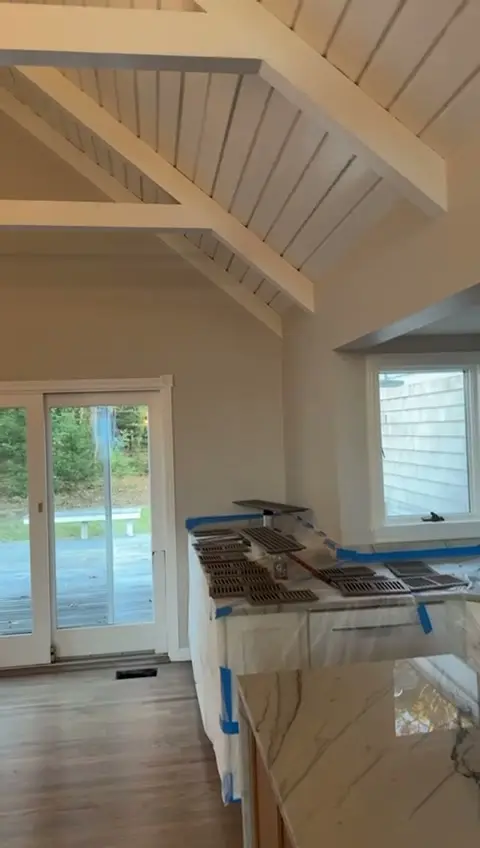
Interior paintingRepainting rooms in a town built mostly after the war
The Census age table for Paxton has a clear peak. Of 1,753 housing units, 674, or 38.4%, went up in the 1950s and 1960s, and the median year built is 1967. Another 171 units, 9.8%, date from 1939 or earlier. For interior work, those dates tell us what is likely under the current paint: the wall material, the number of coats already on the trim, and whether any of those coats contain lead.
Nothing replaces looking at your own rooms, though. A 1962 ranch may have been gutted and redone in drywall; an 1880s farmhouse may still have its first plaster. The visit starts with the walls, not the paint chart.
Plaster, rock lath and drywall
Houses from the middle of the century fall in a transition period. Some have plaster troweled over gypsum lath panels, some have early drywall, and some have both where later additions met the original rooms. Plaster is hard and durable but develops long hairline cracks and small areas that lift away from the lath. Drywall shows its age differently: popped nail heads, tape seams that bubble, and dents behind doors.
Each gets its own repair. Plaster cracks are opened, taped or filled with a setting compound and sanded flat, and loose areas may need to be reattached before any patching. Drywall nail pops are reset with screws and spotted. Primer goes over every patch so the finish coat does not flash, meaning dull spots where the filler absorbed paint differently from the wall around it.
Old trim and lead-safe prep
Residential lead paint was banned nationally in 1978, and 67.2% of Paxton housing units were built before 1980 (the Census groups the 1970s together, so the exact pre-1978 share is a little lower). In a house of that age, the window sills, stair rails, baseboards and doors are the parts most likely to carry original layers, because they were painted with durable enamels and are touched, bumped and opened every day.
Before any sanding or scraping on pre-1978 surfaces, the work area is set up to contain dust: plastic on floors and doorways, misting instead of dry scraping, HEPA vacuuming and careful cleanup. Families with young children or anyone pregnant in the house should read our lead-safe painting page before choosing a start date. In homes built after 1978 the prep is simpler, but sanding glossy trim still matters for adhesion.
Ceilings and the order of work
Ceilings come first so drips and roller spatter land on walls that have not been finished yet. Stains from an old roof or bathroom leak get a stain-blocking primer before the flat ceiling paint, or they bleed through again within days. Textured or popcorn ceilings in homes from the 1960s and 1970s should not be scraped until a sample has been tested, because some texture products of that period contained asbestos.
After ceilings come walls, then trim and doors, usually in a satin or semi-gloss that wipes clean. For a house with older oil-based enamel on the trim, a bonding primer goes on first so a water-based topcoat does not peel.
Planning the job
Interior work can run through any month, which makes winter a sensible time for it; our post on painting with the windows closed covers low-odor products and air flow when the house is sealed up. Rooms are emptied to the center or moved out, outlets and hardware come off, and furniture and floors are covered.
AJ Painting is based in Ashland, licensed and insured, and offers a free on-site visit with a written estimate. If you are also thinking about the outside of the house, see exterior painting in Paxton; for the kitchen, see cabinet painting.
Paxton at a glance