
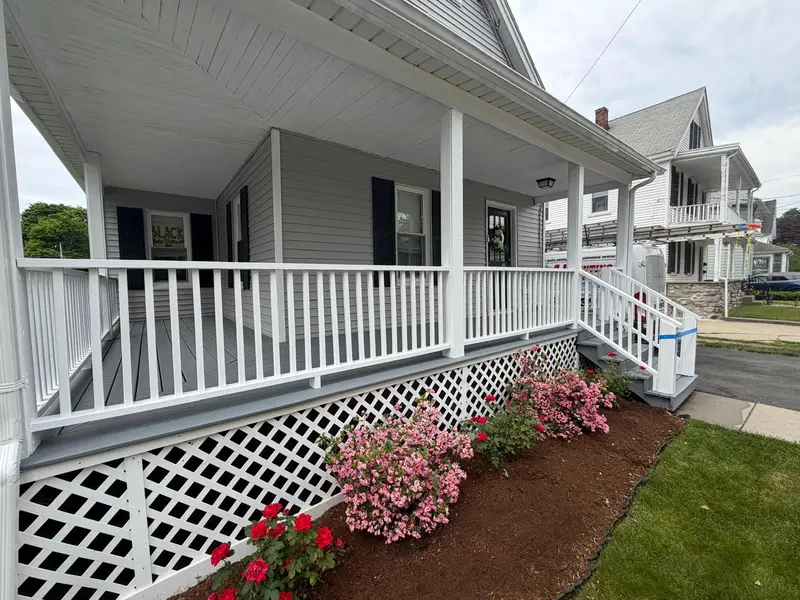
Norwood, MA
Porch Floor, Steps & Railings in Norwood, MA
A Norwood home's front and back porches: floor boards and steps painted gray, with railings, balusters and lattice skirting in white.
See the photos →Cleaning, sanding, staining or painting decks, porches and railings at Wakefield homes, with the product chosen for how much sun and moisture each deck gets.
Just over half of Wakefield's housing units (53.8%) are single-family detached homes. The town's housing plan classifies about 18% of its land as wetland or water, and places federal flood hazard areas mainly beside Lake Quannapowitt, near the Mill River and by Reedy Meadow. A deck on low, damp ground or under heavy shade dries slowly after rain, and that alone shortens the life of any coating.
Choosing the right finish starts with where the deck sits, how old the boards are and what is already on them.
Pressure-treated pine, cedar and composite each take coatings differently, and an older deck may mix materials after past repairs. A quick water test shows whether the wood still absorbs: if drops bead up, an old sealer is still there and has to come off before new stain can soak in.
Soft or spongy boards, loose railing posts and popped fasteners are noted at the visit. Coating a board that is already rotting only hides the problem for one season.
Penetrating stains soak into the wood and wear away gradually, which makes the next maintenance coat simple. Solid stains and deck paints form a film that hides more of the grain and older repairs, but once a film coat starts to peel on a tread, it has to be scraped before recoating.
The paint vs. stain deck comparison goes through the trade-offs in detail. A split approach is also possible: a solid color on railings and skirting, where feet do not wear it, and a penetrating stain on the floor boards.
Gray, weathered wood is cleaned with a deck cleaner and brightener, rinsed, and given time to dry before any stain goes on. Coating wet wood traps moisture and invites peeling. On a deck that sits in shade, that drying window can be longer than on a sunny one.
Manufacturers list temperature and rain-free windows on every can, so deck work fits the warmer months. Our post on deck stain and New England winters explains what freeze-thaw cycles do to each kind of finish.
With 31.8% of the town's housing built in 1939 or earlier, an older property may have a painted porch and railings rather than a modern deck. If that porch paint dates from before 1978, scraping it falls under the EPA's renovation rule, and the lead-safe painting page explains the containment involved.
The house siding can be painted in the same season; see exterior painting in Wakefield. Estimates cover Greenwood, Montrose and the West Side.
| Single-family detached homes | 53.8% of housing units (U.S. Census ACS 2020–2024 5-year, table B25024) |
| Land classified as wetland or water | About 18% of town (Town of Wakefield Housing Production Plan FY2026–2030, pp. 71–77) |
| Lake Quannapowitt | About 250 acres, 3-mile shoreline (Friends of Lake Quannapowitt FAQ) |
| Housing built in 1939 or earlier | 31.8% of units (U.S. Census ACS 2020–2024 5-year, table B25034) |
These jobs were in other towns, not in Wakefield. Each card names the town where the work was done.
A Norwood home's front and back porches: floor boards and steps painted gray, with railings, balusters and lattice skirting in white.
See the photos →It can, with the right prep and product. The boards are cleaned to remove mildew, then left to dry fully before coating; a penetrating stain with a mildewcide is usually a better fit than a film-forming paint on a deck that rarely dries out. Trimming nearby brush to let air through also helps.
Loose paint is scraped and sanded off the treads. If enough bare wood is exposed, switching to a penetrating stain avoids repeating the peel; otherwise a solid deck coating goes back on over well-bonded areas after spot priming.
Fresh pressure-treated lumber is often too wet to accept stain. The usual check is whether water soaks in; once it does, the deck is ready. Check the stain manufacturer's guidance as well.
Composite boards are generally not stained or painted; they are cleaned. Wood railings, posts and trim around a composite floor can still be stained or painted to match.
Yes. Porch floors and railings on a pre-1978 house may have lead in older paint layers, so scraping is done with lead-safe containment. A porch floor enamel is then used rather than a deck stain.
AJ does not post prices. The deck staining cost guide compiles Massachusetts market data; deck size, the number of railing balusters, stripping an old coating and any board replacement shape the total.
Free on-site visit and written estimate from AJ Painting, licensed and insured, based in Ashland. Call (508) 258-4325, Monday–Saturday, 7AM–6PM.
5.0 on Google · 35 verified reviews · Licensed & insured · Written quote in 48h