
Norwood, MA
Porch Floor, Steps & Railings in Norwood, MA
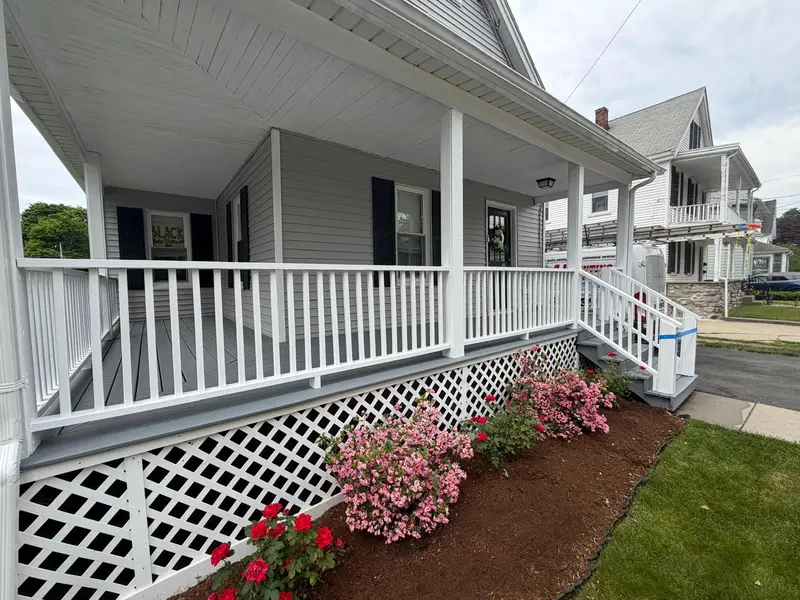
A Norwood home's front and back porches: floor boards and steps painted gray, with railings, balusters and lattice skirting in white.
See the photos →Washing, stripping where needed, and stain or floor paint for decks, porches and outdoor stairs in Taunton, chosen for the wood and for how wet the spot stays.
Single-family detached homes make up 44.8% of local housing, which leaves more than half of units in attached homes, multi-unit buildings and mobile homes. That split matters outdoors. A private backyard deck is one owner's decision; a set of rear porches on a three-unit building is a shared structure with stairs, landings and railings that everyone uses.
Whatever the setting, horizontal wood fails first. Rain sits on it, snow melts into it, and foot traffic grinds the finish away in paths to the door. Siding on the same house can look fine while the deck boards have gone gray.
Local NOAA normals show 79.9 days a year with at least a tenth of an inch of precipitation, 25.7 inches of snow, and 127.8 nights at or below 32°F. Every freeze after a wet day pulls at the end grain and the screw holes. A penetrating stain lets the wood shed some of that water while still breathing; a thick film over wet wood traps it and peels.
Spots that dry slowly deserve a closer look: boards under a downspout, steps on the north side, and decks built low to the ground where air does not move underneath. Soft wood there should be replaced before any coating, since stain does not restore rot.
Pressure-treated pine needs time to dry after it is built; coat it once a sprinkle of water soaks in rather than beading. Cedar takes an oil-based semi-transparent stain well and grays quickly without one. Composite boards are not stained at all, just cleaned, unless the manufacturer says otherwise.
An existing solid stain limits your choices. Going back to a see-through finish means stripping to bare wood, while staying with solid means scraping loose areas and recoating. The paint vs. stain comparison sets out how each wears on floors and on rails.
With 34.8% of housing built in 1939 or earlier, the outdoor floor that needs work may be a front porch rather than a deck. Painted tongue-and-groove porch boards take a primer and porch-and-floor enamel, not deck stain. The railings and columns around them may be painted to match the house trim.
Old porch paint deserves caution. On a pre-1978 house, federal rules require lead-safe methods once paid work disturbs more than 20 square feet of exterior paint, and a full porch floor easily exceeds that. Our lead-safe page explains what containment looks like outdoors.
Read the stain label for its minimum temperature, then compare it with local normals: lows average 47.8°F in May and 43.0°F in October, while June through September lows run from 54.3°F to 62.8°F. Midsummer gives the most room, as long as the boards are out of direct midday sun when coated so the stain does not flash-dry. Wood should also be dry from the last rain; a day or two of sun after a storm is a reasonable minimum.
For the house itself, see exterior painting. The Weir Village page has notes on that neighborhood.
| Single-family detached share | 44.8% of housing units (11,281) (U.S. Census ACS 2020–2024 5-year, table B25024) |
| Days with ≥0.10 in of precipitation | 79.9 per year (NOAA NCEI Climate Normals 1991–2020, station USC00198367) |
| Normal lows, May / October | 47.8°F / 43.0°F (NOAA NCEI Climate Normals 1991–2020, monthly, station USC00198367) |
| Average annual snowfall | 25.7 in (NOAA NCEI Climate Normals 1991–2020, station USC00198367) |
| Federal lead-safe trigger, exterior | More than 20 sq ft of paint disturbed (pre-1978 homes) (U.S. EPA, RRP Program for Contractors) |
These jobs were in other towns, not in Taunton. Each card names the town where the work was done.
A Norwood home's front and back porches: floor boards and steps painted gray, with railings, balusters and lattice skirting in white.
See the photos →Not by itself. The surface needs cleaning with a mildewcide or deck cleaner first, and the shade and moisture will bring the growth back without regular washing. A penetrating stain with a mildew inhibitor helps, and trimming back plantings that keep the boards damp helps more.
If the building is condo-owned, the association documents generally say who controls shared exterior parts. If you own the whole building, it is your call, but tenants on each level should get notice because their stairs and porches will be off-limits while the coating dries.
With October lows near 43°F on average, it comes down to the label minimum and the forecast. Coat in the middle of a dry, mild day, and skip it if frost or rain is expected that night. Our post on deck stain and New England winters covers fall timing.
Paint and solid stain hide worn wood, but they form a film that can peel on a walking surface. Semi-transparent stain shows more grain and wears away evenly, so it is simpler to refresh. One workable split is stain on the floor and paint or solid stain on the railings.
Deck size is only one factor. Stairs, railings, the condition of the old finish, and any board replacement shift the total. The deck staining cost guide uses Massachusetts market data, and AJ Painting gives a written estimate after a free visit.
No. A painted porch floor takes primer and porch-and-floor enamel, and on an older house the scraping may need to follow lead-safe rules.
AJ Painting reviews the wood and the existing finish on a free on-site visit and puts the recommended system in a written estimate. Call (508) 258-4325.
5.0 on Google · 35 verified reviews · Licensed & insured · Written quote in 48h