
Norwood, MA
Porch Floor, Steps & Railings in Norwood, MA
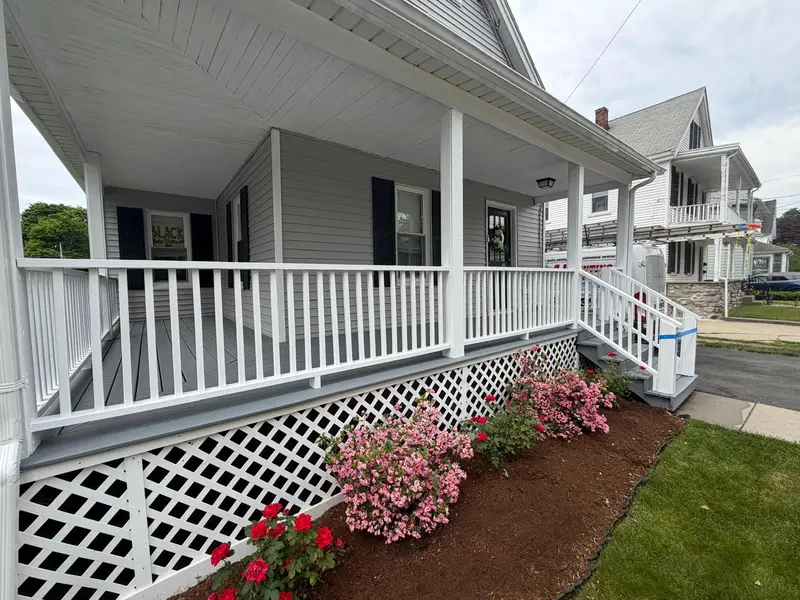
A Norwood home's front and back porches: floor boards and steps painted gray, with railings, balusters and lattice skirting in white.
See the photos →Deck boards, rails, stairs and porch floors cleaned, repaired and finished with a stain or coating suited to the wood and to how much sun the deck actually gets.
Outside the Town Center, house lots run two to four acres, and the town's open space plan describes them as mostly wooded with homes widely spaced. A deck tucked into that kind of setting rarely suffers from too much sun. Its trouble is the opposite: needles and leaves that hold water against the boards, slow drying after every rain, and green or black growth in the gaps.
Not every lot is shaded. The same plan says developments with larger homes since the 1990s involved more clearing, and a deck on an open lot takes direct summer sun that bleaches stain and opens checks in the wood. Before choosing a product, note how many hours of sun the deck really gets.
EPA notes that manufacturers stopped producing CCA-treated wood for homeowner uses in December 2003, and that it does not require removal of existing decks. It also says regularly applying a penetrating oil- or water-based stain may reduce the chemicals leaching out, so keeping an older deck coated serves a purpose beyond looks.
On a shaded deck, a stain with mildew-resistant additives and a penetrating formula usually wears better than a thick film, because a film that traps moisture tends to lift. On a sunny deck, a semi-transparent or solid stain with more pigment slows graying. Either way, horizontal boards wear faster than rails, so the walking surface often needs attention before the rest.
The paint vs. stain comparison explains the long-term trade-off, and how deck stain survives a New England winter describes why snow and freeze cycles go after the flat surfaces first.
Carlisle homes rely on private wells and septic systems, since the town has no municipal water or sewer. Deck prep uses cleaners and brighteners, and their runoff goes into the soil around the deck. Ask what products will be used, follow the label on rinsing and plant protection, and keep the work away from the wellhead.
The Concord River and its extensive wetland floodplain form the town's southeast boundary with Bedford. If your deck stands on low, wet ground, have the framing, post bases and ledger checked for rot along with the boards.
The order is clean, rinse, brighten, let dry, sand raised fibers, then stain. Loose nails get reset or swapped for screws, and rotted boards, stair treads and rail caps are replaced before finishing so new wood is stained with the rest. Painted porch floors on houses older than 1978 are scraped under lead-safe rules once more than 20 square feet of paint is disturbed; see the lead-safe painting page.
Stain needs dry wood and a few dry days to cure, which puts the season between late spring and early fall. If the house siding is also on the list, finishing the deck after the walls keeps drips off the new stain; the exterior painting page covers that side.
| Typical lot outside Town Center | Mostly wooded tracts of 2 to 4 acres (Carlisle 2020/2021 Open Space and Recreation Plan) |
| Single-family detached homes | 93.2% of housing units (1,682 of 1,805) (U.S. Census ACS 2020–2024 5-year, table B25024) |
| Water and sewer | No municipal service; private wells and septic (Carlisle 2020/2021 Open Space and Recreation Plan) |
| CCA lumber for homeowner use | Discontinued December 2003 (U.S. EPA, Chromated Arsenicals (CCA)) |
| Southeast boundary | Concord River, with an extensive wetland floodplain (Carlisle 2020/2021 Open Space and Recreation Plan) |
These jobs were in other towns, not in Carlisle. Each card names the town where the work was done.
A Norwood home's front and back porches: floor boards and steps painted gray, with railings, balusters and lattice skirting in white.
See the photos →Stain alone will not. The growth has to be cleaned off and the wood allowed to dry before any coat goes on. A penetrating stain with mildew inhibitors, plus regular sweeping of leaves and needles, slows the return.
A deck from before 2004 may be CCA-treated. EPA does not call for removing it; wear goggles and a dust mask when sawing, never burn the scraps, and keep the boards coated with a penetrating stain. Low-pressure washing avoids gouging the wood.
Use products labeled for deck cleaning, follow the rinse and plant-protection directions, and keep the work and runoff away from the wellhead. Ask your painter which cleaner and brightener they plan to use.
Only once the solid stain is fully stripped or sanded off. A transparent stain needs bare wood to soak into, and it will not cover the patchy color an old film leaves behind.
Use the water test rather than the calendar. When water soaks in within a few minutes in the area that gets the most wear, the finish is spent and it is time to clean and recoat.
Board area, railings and stairs, how much old finish has to come off, and any board replacement drive it. The deck staining cost guide gives Massachusetts market data, and AJ Painting writes up an estimate after a free on-site visit.
AJ Painting is licensed and insured. Call (508) 258-4325, Mon–Sat 7AM–6PM, for a free visit and a written estimate on your deck or porch.
5.0 on Google · 35 verified reviews · Licensed & insured · Written quote in 48h