
Norwood, MA
Porch Floor, Steps & Railings in Norwood, MA
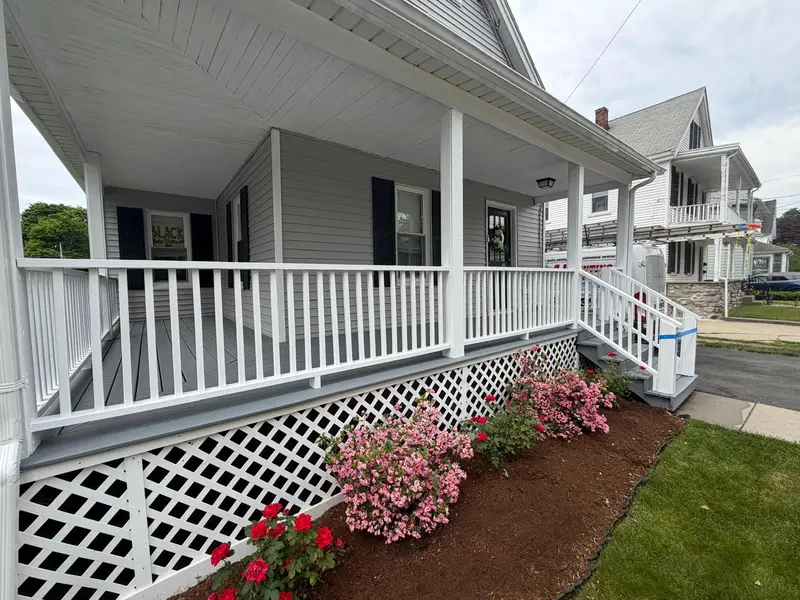
A Norwood home's front and back porches: floor boards and steps painted gray, with railings, balusters and lattice skirting in white.
See the photos →Decks, railings, stairs and porch floors cleaned, repaired where needed and finished with a stain or coating suited to the wood, its age and how wet the yard stays.
A deck floor is flat, so snow melts on it slowly, rain pools in the board gaps, and summer sun hits it straight on. That combination wears out a stain far faster than the same product on a wall. The practical goal is a finish you can recoat on a schedule, not one that looks perfect for a season and then peels in sheets.
Single-family detached houses hold 54.4% of the city's housing units and attached single-family homes, such as townhouses, add 6.6%. Owners of a detached house decide on their own deck; in an attached development the association may set the color and timing, which our condo painting page covers.
Attleboro is one of the towns in the Ten Mile River watershed, which covers about 54 square miles and takes in the Bungay River and Sevenmile Brook. If your yard slopes toward a brook, a wetland or a wooded edge, the deck may stay damp for long stretches. Wet wood grows mildew and algae, and stain applied over damp boards does not soak in.
On a deck like that, the order of work matters: clean to kill the growth, let the boards dry until water soaks in instead of beading, then apply a stain that contains a mildewcide. Rinse water from cleaners and strippers should be kept out of storm drains and away from plantings and any nearby wetland.
Houses built from 1980 through 1999 make up 23.8% of the stock. Decks from those years, if the original boards are still in place, may be CCA-treated lumber, the arsenic-based preservative that the EPA says manufacturers stopped making for homeowner uses in December 2003. The EPA advises goggles and a dust mask when cutting it and warns against burning it at home.
For a stain job, that means sanding is kept light and dust is collected rather than blown around the yard, and any boards that get replaced go out with the trash rather than into a fire pit. Boards that are split, cupped badly or soft near the posts are a carpentry fix before any finish goes on.
Moving toward more opacity is easy; moving back means stripping. Our paint vs. stain comparison goes through the trade-offs.
About 24.1% of units date to 1939 or earlier. Where an older house has a covered porch with a painted tongue-and-groove floor, the sensible maintenance is more paint, using a porch-and-floor enamel, not a switch to stain. Under the current coat there may be decades of earlier paint, including lead paint from before 1978, so scraping is done with containment described on our lead-safe painting page. Posts, rails and ceilings on those porches are part of the house trim; see exterior painting.
| Watershed | Ten Mile River, about 54 sq mi; tributaries include the Bungay River and Sevenmile Brook (Massachusetts Rivers Alliance) |
| Detached and attached single-family homes | 54.4% detached; 6.6% attached (U.S. Census ACS 2020–2024 5-year, table B25024) |
| Homes built 1980–1999 | 23.8% of units (4,556) (U.S. Census ACS 2020–2024 5-year, table B25034) |
| End of CCA-treated wood for homeowner use | December 2003 (national) (U.S. EPA) |
These jobs were in other towns, not in Attleboro. Each card names the town where the work was done.
A Norwood home's front and back porches: floor boards and steps painted gray, with railings, balusters and lattice skirting in white.
See the photos →Original boards from before 2004 may be CCA-treated. Light sanding with dust collection and a mask is the cautious approach, along with cleaning up dust rather than hosing it into the lawn. Don't burn any removed boards.
A stain with a mildewcide slows the growth, but it won't stop it if the boards never dry. An annual cleaning, trimming back overhanging branches and keeping the gaps between boards clear of debris do as much as the product.
Only by stripping the solid stain, which takes a chemical stripper, rinsing and a brightener, and sometimes sanding. Some boards may still hold pigment in the grain, so expect a slightly uneven result.
Check your association's rules first. The master deed, bylaws or rules may set the deck color, and sometimes the product, so the buildings match.
Floor area, railing length and whether an old coating has to be stripped drive the price. The deck staining cost guide compiles Massachusetts market figures, and the free on-site visit gives you a written number for your deck.
Floors in full sun wear first; railings and shaded areas last longer. Our post on deck stain and New England winters explains how freeze-thaw cycles affect the timeline.
We'll check the boards and the current finish and put a recommendation in a written estimate. Call (508) 258-4325, Monday to Saturday, 7AM to 6PM.
5.0 on Google · 35 verified reviews · Licensed & insured · Written quote in 48h