
Norwood, MA
Porch Floor, Steps & Railings in Norwood, MA
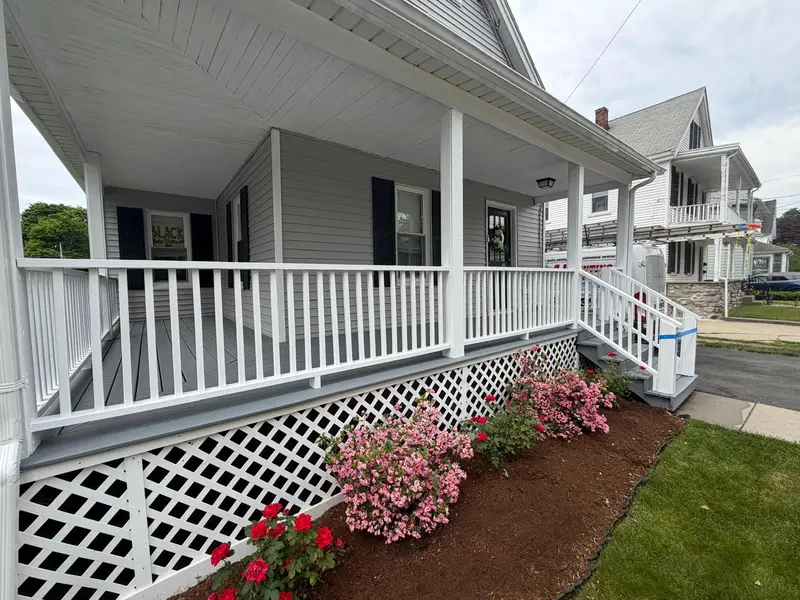
A Norwood home's front and back porches: floor boards and steps painted gray, with railings, balusters and lattice skirting in white.
See the photos →Washing, repairing and staining or painting decks, porch floors, railings and steps for Abington homeowners.
Census data counts 63.2% of the town's housing units as single-family detached and another 7.6% as single-family attached, and 72.7% of occupied homes are owner-occupied. Attached homes in particular can belong to a condominium or homeowners association whose documents set deck colors or maintenance duties; an FAQ below covers that case.
What decides the finish is the wood, the sun and water the boards get, and the coating already on them. A stain that suits a sunny cedar deck can fail quickly on a shaded pressure-treated one.
Pressure-treated pine is common on backyard decks. When new, it can hold enough moisture that stain won't soak in, so it needs a dry-out period before the first coat. A water test helps: drops that bead mean wait, drops that soak in mean it's ready.
Cedar resists rot naturally but grays in the sun; a penetrating oil or semi-transparent stain keeps its color. Fir is the traditional porch floor and is usually painted with a porch-and-floor enamel. Composite and PVC boards don't need stain, only cleaning, though some can be coated with products made for them.
A deck under tall trees or on the north side of a house dries slowly after rain and collects leaves and pollen. Those boards grow mildew and algae, turn slippery, and hold water against the finish. A deck in full sun has the opposite problem: ultraviolet light breaks down the stain and the wood checks and splinters.
Low-lying back yards and decks built close to the ground also trap moisture underneath, which shows up as cupped boards and rot at the joists. Fixing drainage or clearing debris from the gaps between boards does more for the finish than a second coat.
Semi-transparent stain soaks in and wears away gradually, so recoating is mostly cleaning and a fresh coat. Solid stain and paint sit on the surface; they hide worn wood and look uniform, but on walking surfaces they can peel where water sits and feet travel. Our paint vs. stain comparison lays out the trade-offs, and the post on deck stain through a New England winter covers freeze-thaw wear.
Railings and balusters are vertical and shed water, so a solid color there often lasts longer than on the floor. One option combines the two: a solid color on rails and a semi-transparent stain on the boards.
Stain needs several dry days, warm enough temperatures and no rain right after application. By mid-fall, heavy dew can keep boards wet until midday. An estimate can still happen now so the cleaning and staining are ready to go in spring. If the house needs work too, see exterior painting in Abington; for local notes, see our South Abington page.
| Single-family detached homes | 63.2% of housing units (4,095 of 6,479) (U.S. Census ACS 2020–2024 5-year, table B25024) |
| Single-family attached homes | 7.6% of housing units (493) (U.S. Census ACS 2020–2024 5-year, table B25024) |
| Owner-occupied homes | 72.7% of occupied units (U.S. Census ACS 2020–2024 5-year, table B25003) |
These jobs were in other towns, not in Abington. Each card names the town where the work was done.
A Norwood home's front and back porches: floor boards and steps painted gray, with railings, balusters and lattice skirting in white.
See the photos →Stain alone won't. The green is algae or mildew growing where the boards stay damp. A deck cleaner kills it, and a stain with a mildewcide slows it down, but trimming branches for more sun and clearing leaves from the gaps does the most good.
Only if the boards pass the water-drop test. If water still beads on the surface, the wood is too wet, and stain applied now won't penetrate. Waiting until spring is fine for new treated lumber.
Going over peeling film usually means it peels again, taking the new coat with it. The loose material has to be stripped or sanded off first. Switching the floor to a semi-transparent stain after stripping can cut down on future peeling.
If your home is part of a condominium or homeowners association, the deck may be a limited common element with rules on color or who maintains it. Check the documents or ask the manager before choosing a stain.
Railing count, stairs, board condition and whether stripping is needed drive the cost more than square footage. The deck staining cost guide gives Massachusetts market ranges, and a free visit gets you a written estimate.
Only after the paint is fully removed, since stain can't soak through a film. On an older porch, that stripping may involve lead-safe methods, so it's often easier to keep the floor painted with a good porch enamel.
AJ Painting is licensed and insured. Call (508) 258-4325, Monday to Saturday, 7AM to 6PM, for a free on-site visit and written estimate.
5.0 on Google · 35 verified reviews · Licensed & insured · Written quote in 48h