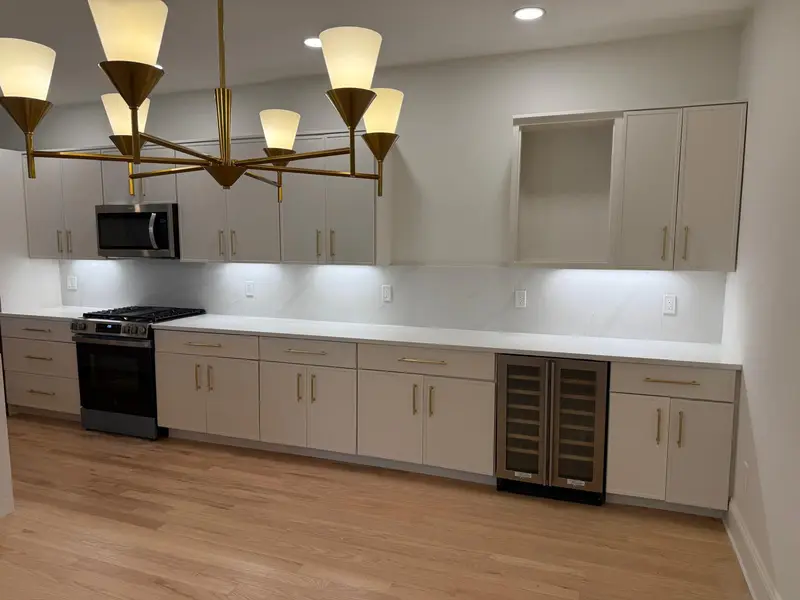
Cabinet painting, ShrewsburyDeciding whether your cabinets should be painted or replaced
Cabinet painting is a bet on the boxes. If the frames are solid, the drawers glide and the layout suits how you cook, a new finish can change the room without the demolition and installation that new cabinetry involves. If the sink base is swollen from a leak or the doors are delaminating, paint only hides the problem for a while.
Shrewsbury kitchens come from many different decades. The 1990s produced 3,294 of the town's 15,393 housing units, more than any other decade in the Census table, while 2,351 date from the 1950s. A 1950s kitchen may hold site-built painted cabinets or a later remodel, and a 1990s kitchen may still have its first set of factory cabinets. Opening the doors and looking at the construction tells you more than the year on the deed.
Reading the material
Solid wood doors on plywood or solid-wood boxes paint best. Red and white oak have open pores that remain visible as a ribbed texture under enamel; a grain filler before priming gives a smooth, sprayed look, while skipping it keeps the wood character. Maple, cherry and birch have tighter grain and need no filler.
MDF doors take paint evenly once sealed, though routed profiles and cut edges soak up primer and need an extra pass. Thermofoil, a vinyl skin heat-pressed onto MDF, is a poor candidate; once it starts peeling near the stove or dishwasher, replacing the doors makes more sense than coating them. Melamine and laminate can be painted with bonding primers, though the result depends on the surface being intact and clean.
Townhouses and condo kitchens
Not every kitchen in town belongs to a detached house. The Census counts 1,213 single-family attached units and 3,152 units in buildings of five or more. In an attached or condo unit, the association's rules may limit work hours, spraying and where equipment can be set up, even when the cabinets themselves belong to the owner. Our condo painting page for Shrewsbury covers those approvals in detail.
Old painted cabinets and lead
Built-in china cabinets, pantry shelving and original kitchen cabinets in a house from before 1978 may hide lead under newer paint. Sanding them to prep for a new finish is exactly what turns that paint into dust. Testing a door edge or face frame answers the question first. Where lead turns up, paid work must follow federal lead-safe practices, described on our lead-safe painting page. With 51.0% of local housing built before 1980, the check is worth making on any older kitchen.
How the finish is built
Kitchen grease left on the surface keeps primer from bonding, so the process starts with a thorough degreasing, then a scuff sand, a bonding primer suited to the substrate and two coats of a cabinet-grade enamel. Doors and drawer fronts are removed, numbered and finished separately, then rehung in their own openings. The step-by-step cabinet painting process shows each stage, and our comparison of cabinet painting and replacement goes deeper into which path suits which kitchen.
Enamel dries to the touch quickly but takes weeks to cure fully. Doors should be closed gently and the surfaces wiped with mild soap rather than abrasive cleaners during that period. Swapping hinges or pulls at the same time is a simple way to update the look further.
- Kitchen wall and base cabinets, islands and peninsulas
- Bathroom vanities and linen cabinets
- Built-in hutches, pantries and bookcases
- Grain filling on oak doors when a smooth finish is wanted
- Hardware removal, labeling and reinstallation
Shrewsbury at a glance
| Housing units built 1990–1999 | 3,294 (21.4%), the largest decade (U.S. Census ACS 2020–2024 5-year, table B25034) |
| Housing units built 1950–1959 | 2,351 (15.3%) (U.S. Census ACS 2020–2024 5-year, table B25034) |
| Single-family attached (townhouse-style) units | 1,213 (7.9%) (U.S. Census ACS 2020–2024 5-year, table B25024) |
| Housing units built before 1980 | 51.0% (7,849 of 15,393) (U.S. Census ACS 2020–2024 5-year, table B25034) |