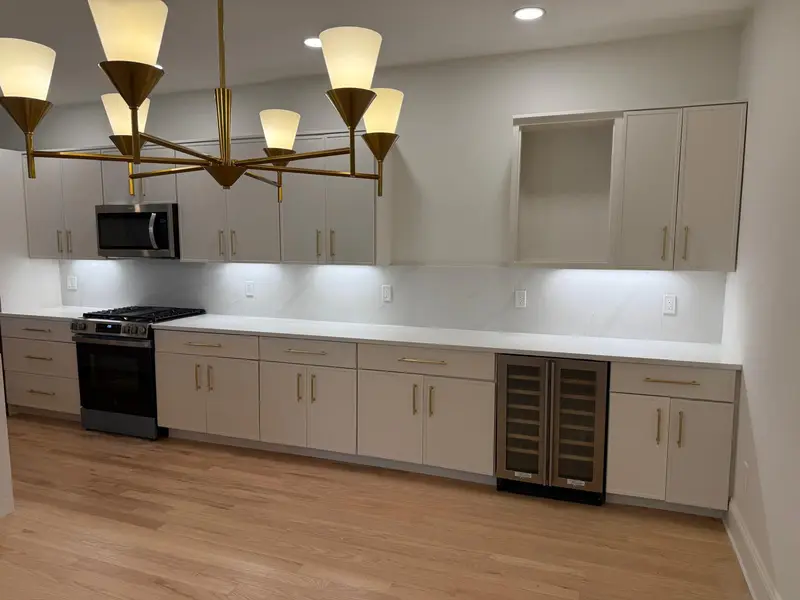
Cabinet painting, Boylston MARefinishing Boylston kitchen cabinets instead of tearing them out
A kitchen's age usually tracks the house's age unless someone has already remodeled. In Boylston the Census puts the median construction year at 1977, and the 1970s and 1950s together account for roughly 35% of all housing units. A kitchen from those decades that still has solid wood face frames and doors is a strong candidate for paint.
Painting keeps the layout, the boxes and the countertops in place and changes how the room looks. It does not fix a bad layout, sagging particleboard shelves or water-swollen sink bases, so the first step is an honest look at what is behind the doors.
Is your kitchen a good candidate?
Our article on cabinet painting versus replacement works through the tradeoff in more detail, including when a hybrid of new doors on existing boxes makes sense.
- Solid wood or plywood boxes and doors that close square: good candidates
- Oak with open grain: paints well, though the grain will show unless it is filled first
- Thermofoil or laminate doors that are peeling: usually better replaced than painted
- Swollen particleboard under the sink: repair or replace that box before refinishing the rest
Getting paint to stick to a decades-old finish
Cabinet doors collect grease and hand oils that ordinary wall prep does not remove. A sound job starts with a degreasing cleaner, then scuff-sanding to dull the old varnish or lacquer, then a bonding primer chosen for the existing finish. On oak or other tannin-rich woods, a stain-blocking primer keeps yellow or brown bleed from showing through a white or light gray topcoat.
If the cabinets went in before 1978 and still carry their original painted finish, that paint may contain lead. Sanding it creates fine dust in the room where food is prepared, so testing comes before any abrasive work, and lead-safe methods apply if it is positive. Our lead-safe painting page explains what that involves.
Built-ins and pantries in the older houses
About 10.5% of the town's housing predates 1940, and Boylston remained a farming community until the mid-1950s. Older farmhouses and village homes may have painted pantry cupboards, china cabinets or built-in bookcases rather than a fitted kitchen. Those pieces may carry many layers of paint, and whether to strip, sand or simply clean and recoat depends on how well the existing layers are bonded.
Houses in the Boylston Center local historic district need commission review only for exterior architectural features, so interior cabinetry and built-ins are a homeowner decision.
Newer kitchens with factory finishes
About 22% of Boylston's units were built in 2000 or later. Cabinets from that era may have a factory-cured catalyzed finish that is hard and slick. Paint will not grip it without thorough scuffing and a primer rated for difficult surfaces. On these, the prep decides whether a new color lasts.
For the step-by-step sequence from removing hardware to rehanging doors, see how kitchen cabinet painting works. If the walls around the cabinets are getting a new color too, the interior painting page for Boylston covers that side.
Boylston at a glance