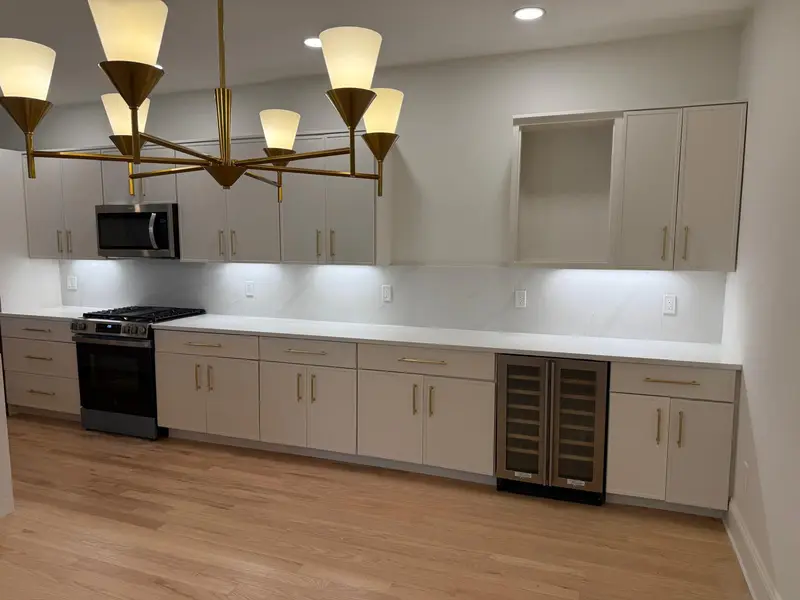
Cabinet painting, Bolton MARefinishing the kitchen cabinets in Bolton's 1990s and 2000s houses
Bolton's housing grew fastest in the 1990s, when 381 units were added, followed by 306 in the 2000s and 296 in the 2010s. Taken together, 47.2% of the town's homes date from 1990 or later. An original kitchen in a house from 1990 to 2009 is now roughly 17 to 36 years old. The boxes and doors may be perfectly solid while the finish has yellowed, worn through at the pulls, or simply dates the room.
That is the situation cabinet painting is suited to. If the layout works, the boxes are square and the doors are real wood or a paintable veneer, a new finish usually costs less than new cabinetry and keeps the countertops in place.
Is your cabinet material a good candidate?
A look at the door edges and the back of a drawer front usually answers the question. The refinish vs. replace guide walks through the decision in more depth.
- Solid hardwood doors (oak, maple, cherry): paint well; open-grained oak shows its grain through paint unless it is filled first
- Wood veneer over plywood or MDF: paintable if the veneer is bonded and not peeling at the edges
- Painted MDF doors: take a fresh coat well after scuffing and priming
- Thermofoil or vinyl-wrapped doors: poor candidates; the film tends to lift, and paint does not fix that
- Laminate: possible with a specialty bonding primer, but durability is lower
Why prep decides how long the finish lasts
Kitchen cabinets collect cooking grease, hand oils and cleaning residue that ordinary paint will not stick to. A durable job starts with degreasing, then scuff-sanding the existing finish, filling dents, and a bonding primer. The topcoat is a cabinet-grade enamel, often a urethane-modified alkyd or waterborne alkyd, that levels out smooth and hardens over the following weeks.
Doors and drawer fronts are usually taken off, labeled and finished flat so the paint does not sag, while the boxes are painted in place. The cabinet painting process article shows the steps in order.
Older kitchens in older houses
Bolton also has 827 housing units (39.7%) built before 1980, including Colonial, Federal and Greek Revival houses in the Bolton Center and Pan National Register districts. In an antique, the kitchen may sit in a later addition, and any built-in cupboards could be old painted woodwork. Lead-based residential paint was legal until 1978, so sanding existing paint in a pre-1978 kitchen calls for lead-safe methods; our lead-safe painting page explains them.
Hand-built cabinetry with raised panels and beaded face frames can be worth keeping for its own sake. A careful repaint in a brushed finish can suit those kitchens better than a sprayed factory look.
Living with the kitchen during the work
With 94.7% of the town's occupied homes owner-occupied, the kitchen being painted is likely the one the household still cooks in. Doors come off for several days, the boxes are masked and painted on site, and the fresh enamel needs gentle use for a few weeks while it reaches full hardness. Planning a temporary prep area makes those days easier.
Bolton at a glance
| Housing units built in the 1990s | 381, the largest single decade (U.S. Census ACS 2020–2024 5-year, table B25034) |
| Housing units built 1990 or later | 47.2% (983 of 2,084) (U.S. Census ACS 2020–2024 5-year, table B25034) |
| Median value, owner-occupied homes | $796,000 (±$49,011) (Census Reporter profile, ACS 2024 5-year) |
| Housing units built before 1980 | 39.7% (827 of 2,084) (U.S. Census ACS 2020–2024 5-year, table B25034) |