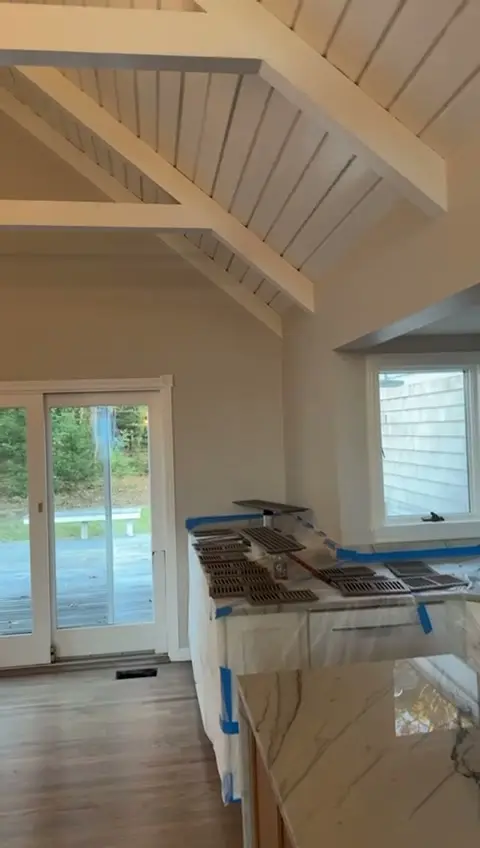
Interior painting, Marlborough MAInterior painting that starts with the year your house was built
Census estimates put the median construction year of local housing at 1974, but that middle number hides a wide spread. About one unit in five (20.8%) dates from 1939 or earlier, while 16.0% went up in 2000 or later. Among single decades, the 1960s (15.4%) and the 1980s (16.0%) account for the largest shares of the units standing today.
Indoors, the build date shapes the job. It points to what the walls are made of, how many coats of old paint sit on the trim, and whether federal and state lead rules come into play before anyone sands a windowsill.
Plaster walls in the older housing stock
A room from before the Second World War is likely to have plaster on lath rather than gypsum board. Sound plaster takes paint well, but aging plaster shows specific symptoms: hairline cracks that follow the lath, bulges where the keys have let go, and ceilings with a map of old patches under several layers of paint.
Paint alone will not hold a crack that is still moving. The more durable fix is to open the crack, secure loose sections, tape and fill with a setting compound, then prime the repair so the finish coat dries to an even sheen. Where a ceiling has delaminated across a wide area, that is a plaster repair question to settle before painting is scheduled.
- Hairline cracks: widened, taped and filled with setting compound
- Loose or bulging plaster: secured or flagged for a plaster specialist before paint
- Water stains: sealed with a stain-blocking primer once the leak source is fixed
- Glossy old enamel on trim: cleaned and deglossed so new paint can grip
Lead paint and the 1978 line
Of the 17,247 housing units counted in the city, 9,753 (56.5%) were built before 1980. The Census groups years by decade, so that figure includes 1978 and 1979, but it gives a fair sense of how many homes predate the federal ban on lead in residential paint.
Two sets of rules follow from that. The EPA's Renovation, Repair and Painting Rule covers paid work in pre-1978 homes once more than six square feet of paint per room is disturbed, a line that scraping a stairwell or sanding every sill and casing in a room can cross. Separately, the Massachusetts Lead Law requires owners to make a pre-1978 home safe when a child under six lives there, and if a child is poisoned, the owner is responsible even without having known about the lead. Our lead-safe painting page covers containment, cleanup and testing.
Trim from different eras
A city survey prepared for the Marlborough Historical Commission in 1994–95 traces the city's residential styles. Queen Anne dominated house building from the late 1880s into the early 1900s, and its details also appeared on more modest rental or resale houses, many of them duplexes or triple houses. Many Dutch Colonial Revivals went up in the late 1920s and early 1930s, especially in the Church Street and Chestnut Hill neighborhoods; bungalows came into their own by the late 1910s, and single-family subdivisions spread from the 1950s onward.
Inside, the age of the house shows in the woodwork. Older profiles can be layered with paint until the edges go soft, so the decision on a mantel or casing is whether to strip built-up layers or simply clean, sand lightly and repaint. Flat stock trim in a later ranch or split-level calls for a different plan, usually caulking gaps where it meets the wall and choosing a sheen that hides minor dents.
Marlborough at a glance
| Median year housing built | 1974 (±3) (U.S. Census ACS 2020–2024 5-year, table B25035) |
| Housing units built 1939 or earlier | 20.8% (3,590 of 17,247) (U.S. Census ACS 2020–2024 5-year, table B25034) |
| Housing units built before 1980 | 56.5% (9,753 of 17,247) (U.S. Census ACS 2020–2024 5-year, table B25034) |
| Queen Anne era | Dominant residential style from the late 1880s to the early 1900s (Marlborough Survey of Historic, Architectural, and Cultural Resources (1994–95), via Marlborough Historical Society) |
| EPA RRP interior threshold | Applies to pre-1978 homes when more than 6 sq ft of paint per room is disturbed (U.S. EPA, Renovation, Repair and Painting Program) |