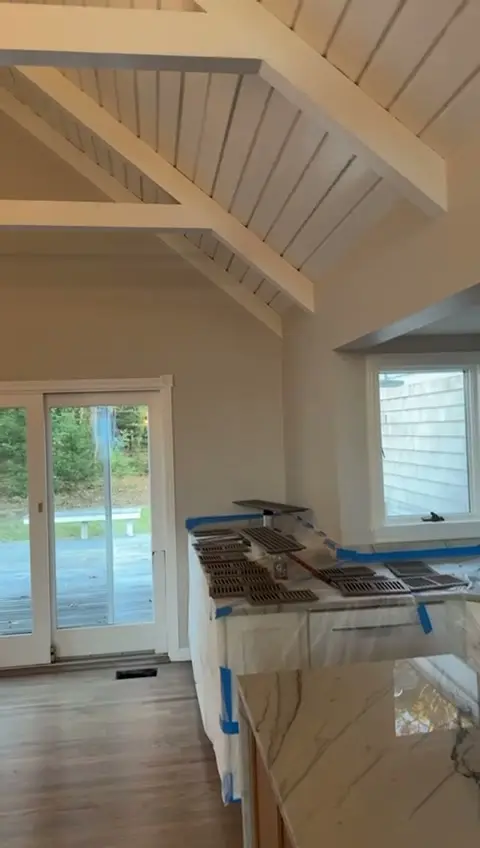
Interior painting, Bellingham MARepainting rooms in a town where the typical house dates to 1973
Census estimates put the median construction year for Bellingham housing at 1973, and the two biggest decade groups are the 1960s (about 20% of units) and the 1970s (about 17%). That matters indoors because a room from those years has had five decades to collect coats of paint, and what lies underneath can include glossy oil enamel on the trim or a flat ceiling paint that was never primed. The condition of what is already on the wall decides how much preparation a new color needs.
The rest of the stock spreads across every era. Roughly 12% of units were built in 1939 or earlier, about 11% in the 1950s, and close to 18% in 2000 or later. A whole-house interior project in one of the newest homes and the same project in a pre-war house are different jobs, even when the square footage matches.
Lead paint and the 62% figure
About 4,141 of the town's 6,691 housing units, or roughly 62%, were built before 1980. The Census groups construction years by decade, so that number is a close stand-in for the federal 1978 cutoff rather than an exact match. Any home built before 1978 can contain lead-based paint. Surfaces that rub or get bumped, such as window sashes, door jambs, baseboards and stair parts, are where old layers can turn into dust.
Federal rules set the line for paid work. Under the EPA Renovation, Repair and Painting rule, a job that disturbs more than six square feet of paint in a room of a pre-1978 home has to be done by a certified firm using lead-safe practices: plastic containment, no open-flame burning and no power sanding unless the tool has a HEPA-exhaust shroud, HEPA vacuuming, and a cleaning check before the room is handed back. Sanding a full run of window sills and casings in a 1960s bedroom can pass that six-square-foot mark quickly. Our lead-safe painting page walks through each step.
- Built 1939 or earlier: 803 units, about 12%
- Built 1950–1979: 3,168 units, about 47% combined
- Built 2000 or later: about 18%
Ceilings, walls and trim in mid-century rooms
Ceilings in older houses can carry textured or acoustic finishes, water stains from past roof or bath leaks, and hairline cracks along joints. Stains need a stain-blocking primer or they bleed through fresh white paint within days. Textured ceilings should be checked before they are rolled, because some older textures loosen when they get wet.
On walls, the usual work is patching nail pops and settlement cracks, sanding glossy patches, and priming repairs so the finish coat dries to an even sheen. Trim is where the most time goes. If a test shows oil-based paint on the woodwork, a bonding primer goes on before any water-based enamel, otherwise the new coat can peel off in strips the first time a door is bumped.
Houses, townhouses and apartments
Single-family detached houses account for about 74% of local units. Another 8% are attached single-family units, and roughly 17% sit in buildings with two or more units, including 202 units in buildings of 50 or more. In an attached home or apartment, the walls you share with a neighbor are still yours to paint inside, but hallways, entry doors facing a corridor and other common areas may follow building rules on color and on when contractors can work.
Close to 79% of occupied homes here are owner-occupied, and about 21% are rented. Tenants should get the landlord's written approval before a color change, and an owner repainting between leases can keep touch-ups simple by using one wall color and one trim color throughout the unit.
How a room is prepared
A standard sequence: furniture moves to the center under plastic, floors get covered with drop cloths taped at the edges, and switch plates and outlet covers come off. Holes are filled, cracks are taped where they keep reopening, and sanded patches are primed. Cut lines along the ceiling and trim come next, then rolling. Two finish coats is the standard for a color change. For a full checklist of what to clear before the crew arrives, see how to prepare a home for an interior paint job.
If the outside of the house needs attention too, the exterior painting page for Bellingham covers siding and trim, and kitchens are handled separately on the cabinet painting page.
Bellingham at a glance
| Median year housing was built | 1973 (U.S. Census ACS 2020–2024 5-year, table B25035) |
| Housing units built before 1980 | About 62% (4,141 of 6,691) (U.S. Census ACS 2020–2024 5-year, table B25034) |
| Units built in the 1960s and 1970s | About 37% (2,446 units) (U.S. Census ACS 2020–2024 5-year, table B25034) |
| Owner-occupied homes | About 79% of occupied units (U.S. Census ACS 2020–2024 5-year, table B25003) |
| Interior lead-safe threshold | More than 6 sq ft of paint disturbed per room, pre-1978 homes (U.S. EPA, Renovation, Repair and Painting Program: Contractors) |