
Norwood, MA
Porch Floor, Steps & Railings in Norwood, MA
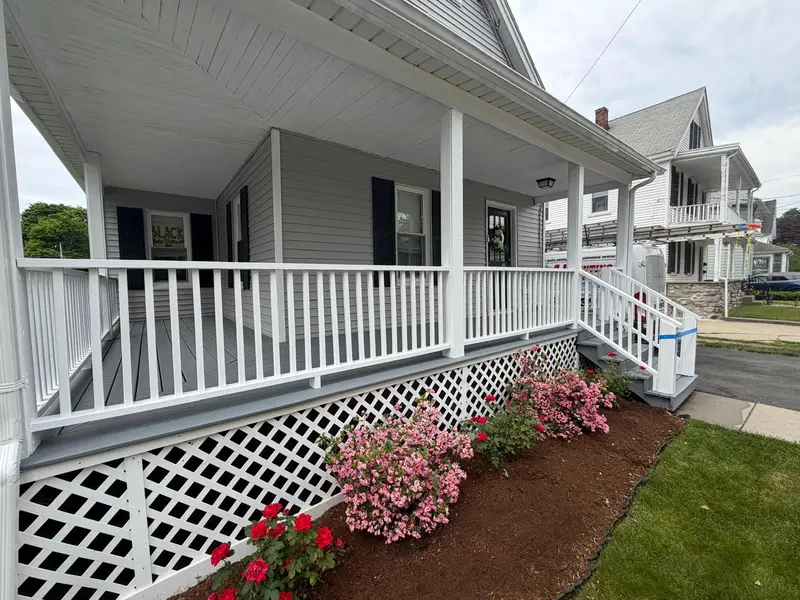
A Norwood home's front and back porches: floor boards and steps painted gray, with railings, balusters and lattice skirting in white.
See the photos →Decks and porches cleaned, repaired and stained or painted with a product suited to the wood, the sun and the shade on your lot.
The Census counts 7,042 single-family detached houses here, 75.4% of local housing units, the building type that can carry its own deck or back porch. And 85.2% of occupied homes are lived in by their owners, so in most households the person deciding when to restain is the one walking on the boards.
Weather is the main reason that decision comes back. The Blue Hill Observatory, on the 635-foot summit of Great Blue Hill inside the town line, reports a long-term average of 49.05 inches of precipitation a year and 62.0 inches of seasonal snowfall for 1885 to 2021. Those are summit readings, not yard measurements, but they point to a climate of frequent rain and regular snow cover on any horizontal wood surface.
Between the Neponset River and the Blue Hills, lots differ in sun, slope and tree cover, so the finish should be chosen for your own deck: a south-facing platform in full sun fades and checks, while one under oaks or beside a north wall stays damp, collects leaves and grows mildew. Boards that sit close to the ground, or that hold water around nail heads, wear faster than the same lumber on an open, elevated frame.
Looking at those conditions before choosing a product matters more than the brand on the can. A shaded deck benefits from thorough cleaning and a finish that breathes, and a sunny one from more pigment to block ultraviolet light.
Pressure-treated pine is a common deck lumber, and new boards often arrive too wet to stain; a few drops of water that bead instead of soaking in mean the wood needs more drying time. Cedar takes stain well but is soft and dents easily. Dense tropical hardwoods such as ipe resist absorbing ordinary stain and call for oils made for them. Composite and PVC decking is generally cleaned rather than stained, so check the manufacturer's guidance before coating it.
Transparent and semi-transparent stains soak in, show the grain and wear away gradually, which makes recoating simpler. Solid stains and deck paints hide the grain and blemishes and resist sun longer, but they form a film that can peel on walking surfaces and is hard to remove if you later want a lighter finish. Rails and balusters, which do not take foot traffic, can carry a solid color while the floor gets a penetrating stain.
Our guide to deck stain through a New England winter goes deeper on product choice, and why prep matters more than painting explains the washing, brightening and sanding that come first.
Not every outdoor floor is a modern deck. With 45.8% of local housing built in 1939 or earlier, a house may have an old covered porch whose tongue-and-groove floor, columns and railings carry decades of paint. On pre-1978 houses those layers may contain lead, and scraping a porch floor is exactly the kind of work the EPA's lead-safe rules cover; see our lead-safe painting page. Porch floors usually take a floor enamel rather than deck stain, and the siding and trim around them are covered on our exterior painting page for Milton.
Stain needs dry wood, a stretch of rain-free hours and temperatures within the label range, which points to late spring through early fall. Washing a deck adds a drying day or two before the finish can go on, so a realistic schedule allows for weather delays.
| Single-family detached homes | 75.4% of housing units (7,042) (U.S. Census ACS 2020–2024 5-year, table B25024) |
| Average yearly precipitation, Blue Hill summit | 49.05 inches (1885–2021) (Blue Hill Meteorological Observatory) |
| Average seasonal snowfall, Blue Hill summit | 62.0 inches (1885–2021) (Blue Hill Meteorological Observatory) |
| Housing units built in 1939 or earlier | 45.8% (4,278 of 9,335) (U.S. Census ACS 2020–2024 5-year, table B25034) |
| Owner-occupied homes | 85.2% of occupied units (U.S. Census ACS 2020–2024 5-year, table B25003) |
These jobs were in other towns, not in Milton. Each card names the town where the work was done.
A Norwood home's front and back porches: floor boards and steps painted gray, with railings, balusters and lattice skirting in white.
See the photos →Once the boards are dry enough to absorb water. Sprinkle a few drops on the surface: if they bead up, wait; if they soak in within a few minutes, the wood is ready. Drying time varies with how wet the lumber was when installed and how much sun the deck gets.
For walking surfaces, a penetrating stain is the safer choice because it wears away rather than peeling. Paint and solid stain suit rails, balusters and skirting better. A deck that already has a peeling solid finish may need stripping before a penetrating stain will work.
Green growth comes from mildew and algae on damp wood. A thorough cleaning with a deck cleaner, rinsing, full drying and a finish with mildew inhibitors help, and trimming back branches or clearing leaves from between boards lets the surface dry faster.
No. Old porch floors and railings are usually painted rather than stained, and on a pre-1978 house the existing paint should be treated as possibly containing lead. Scraping it calls for lead-safe containment and cleanup.
It depends on sun, foot traffic and the type of stain. Penetrating stains wear sooner but recoat easily; solid finishes last longer before fading but are harder to renew. Water no longer beading on the boards is a sign the finish is due.
Deck size, the number of rails and stairs, board repairs, how much stripping or sanding is needed and the product chosen. The deck staining cost guide presents market numbers from across the state; the figure for your deck comes from measuring it in person.
AJ Painting, out of Ashland, is licensed and insured and holds a 5.0 Google rating across 35 reviews. Book a free on-site estimate at (508) 258-4325, Mon–Sat, 7AM–6PM.
5.0 on Google · 35 verified reviews · Licensed & insured · Written quote in 48h