
Norwood, MA
Porch Floor, Steps & Railings in Norwood, MA
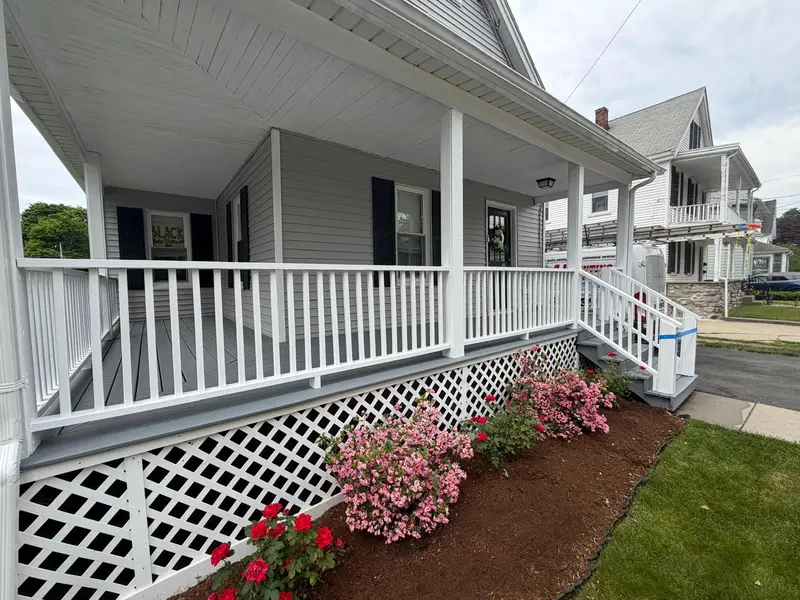
A Norwood home's front and back porches: floor boards and steps painted gray, with railings, balusters and lattice skirting in white.
See the photos →Deck boards, stairs, rails and porch floors washed, repaired and finished with a penetrating stain, a solid stain or porch paint chosen for the wood and its exposure.
A deck finish fails faster than house paint because the boards lie flat. Snow sits on them, water pools along the joints and fasteners, and the top face takes direct sun all summer. The finish you choose now sets the maintenance for years, so decide between a penetrating stain and a film-forming one before the first coat, not after the second one starts peeling.
Single-family detached houses account for 68.6% of local housing units. The 4.8% of units that are single-family attached and the 18.5% in buildings of five or more units are where association rules on deck color and materials are more likely to come into play, so owners there should check their documents before choosing a stain.
Manufacturers stopped making CCA-treated wood for homeowner uses in December 2003. EPA does not call for removing existing CCA decks, and it notes that regularly applying a penetrating oil- or water-based stain may reduce the chemicals leaching out. That makes staining an older deck a maintenance step, not just a cosmetic one.
Penetrating stains soak into the wood and wear away gradually, so each recoat is a cleaning and a fresh application. Solid stains and porch enamels sit on the surface, block more UV and hide mismatched boards, but when they fail they peel, and the peeling has to be scraped before the next coat. The paint vs. stain comparison goes into more detail, and how deck stain holds up through a New England winter explains why horizontal surfaces wear first.
A painted tongue-and-groove porch floor on a house from the 22.6% of local housing built in 1939 or earlier can have lead in its lower layers. EPA's lead-safe rules apply to paid exterior work in pre-1978 housing that disturbs more than 20 square feet of paint, a mark that scraping a porch floor and its steps can pass. The lead-safe painting page covers what that involves.
In the six local historic districts, exterior changes visible from a public way need review, and the town counts the Concord, Assabet and Sudbury Rivers as public ways, so a rear deck facing the water is not hidden from the rules. The guidelines name walls, trim, doors, shutters and fences for color review; whether a deck or porch color change is treated the same way is a question to put to the Planning Division before buying stain. Ordinary maintenance and repair needs no hearing, but the guidelines exclude replacement and any change in color, material, design or size from that exemption, so swapping out rotted porch boards is also worth raising with the Planning Division.
A deck coating can fail because of what lies underneath: mildew, gray loose fibers, or an old finish never removed. The sequence is a deck cleaner, a thorough rinse, a brightener to restore the wood after cleaning, sanding of raised fibers, and full drying time. Popped nails get reset, and soft boards, stair treads and post bases are replaced before any stain goes on.
Stain needs dry boards and a stretch of dry weather for curing, so the season runs from late spring into early fall. If the house is being painted the same year, doing the deck last keeps drips and ladder feet off the new finish; the exterior painting page covers the house side.
| Single-family detached homes | 68.6% of units (4,792 of 6,984) (U.S. Census ACS 2020–2024 5-year, table B25024) |
| Units in buildings with 5+ units | 18.5% (1,290 units) (U.S. Census ACS 2020–2024 5-year, table B25024) |
| CCA lumber for homeowner use | Discontinued December 2003 (U.S. EPA, Chromated Arsenicals (CCA)) |
| Rivers as public ways | Concord, Assabet and Sudbury Rivers count for historic district review (Town of Concord, Historic Districts Design Guidelines (amended August 2015)) |
| Exterior lead-safe threshold | More than 20 sq ft of paint disturbed, pre-1978 housing (U.S. EPA, Renovation, Repair and Painting Program: Contractors) |
These jobs were in other towns, not in Concord. Each card names the town where the work was done.
A Norwood home's front and back porches: floor boards and steps painted gray, with railings, balusters and lattice skirting in white.
See the photos →It may be CCA-treated, since manufacturers made that lumber for homeowner use until December 2003. EPA does not require removal; wear a dust mask and goggles when cutting it, do not burn the scraps, and keep it coated with a penetrating stain.
Sprinkle water on the boards in a sunny spot. If it soaks in within a few minutes instead of beading, the finish is worn and the wood is ready to be cleaned and recoated.
Ask the Planning Division first. Paint color changes on walls, trim, doors, shutters and fences visible from a public way are reviewed, and the town can tell you whether your porch is handled the same way.
Only after the paint is completely stripped or sanded off. A semi-transparent stain cannot soak into wood that is still sealed by an old film.
Start with the association documents, which may set approved colors or assign deck upkeep to the association. If nothing is specified, matching the neighbor's product avoids a visible line between units.
Board area, the length of railings and stairs, stripping old film, and replacing damaged wood make the biggest difference. See the deck staining cost guide for Massachusetts market data; AJ Painting provides a written estimate after a free on-site visit.
AJ Painting is licensed and insured. Call (508) 258-4325, Mon–Sat 7AM–6PM, for a free visit and a written estimate for your deck or porch.
5.0 on Google · 35 verified reviews · Licensed & insured · Written quote in 48h