
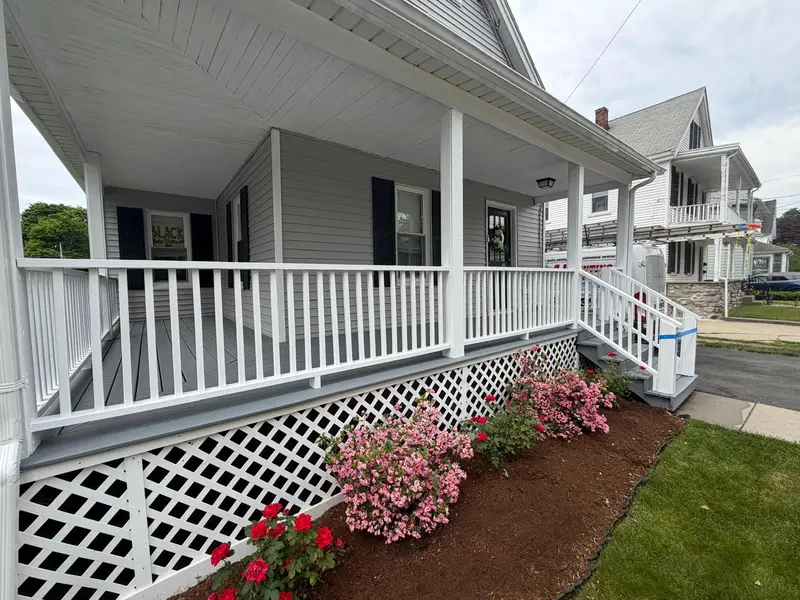
Norwood, MA
Porch Floor, Steps & Railings in Norwood, MA
A Norwood home's front and back porches: floor boards and steps painted gray, with railings, balusters and lattice skirting in white.
See the photos →Burlington's postwar subdivisions were laid out on half-acre lots, which leaves room behind the house for a deck. How long its finish lasts depends on the wood, the sun it gets, and how wet the yard stays.
According to Burlington's Comprehensive Master Plan, the town grew through subdivisions of half-acre lots, and 20,000 square feet remains its predominant residential lot size. With 70.5% of housing units being detached single-family homes, by Census count, a typical lot of that size leaves room behind the house for a deck, a porch or both.
The first question for any deck is what it's made of. The answer decides whether we clean and stain, strip and restain, paint, or recommend leaving it alone.
The master plan notes that earlier development along the town's brooks and wetlands has created flooding concerns, and that FEMA has mapped flood-prone areas in town. It also counts 17 certified vernal pools and another 30 potential ones. If your lot sits near wet ground, the deck framing and lower boards may stay damp longer than the rest of the house.
On a deck like that we pay attention to boards close to the ground, posts and stair stringers, and to mildew in the gaps. Stain can't protect wood that is already soft, so rotted boards get replaced before any coating. A penetrating finish that lets the wood breathe is generally a safer pick than a thick film where moisture comes from below.
We start by washing the deck with a wood cleaner, using a low-pressure rinse so we don't raise the grain or gouge soft pine. Old failing stain is stripped where needed and the wood is brightened. The deck then has to dry, usually a day or two depending on the weather, before any stain goes on.
Stain goes on board by board, with railings and balusters brushed rather than sprayed so that runs don't drip onto finished boards. Stairs are done last so you have a way off the deck. Like all exterior coatings, stain needs dry wood and temperatures within the label's range, so deck work is planned for late spring through early fall.
Burlington's housing has a median build year of 1972 and 62.2% of units built before 1980. A deck may be newer than the house, but painted porch railings, steps and trim on the house can be. If we would disturb more than 20 square feet of that older paint on a pre-1978 home, the EPA lead-safe rule applies; our lead-safe painting page explains it.
If the house siding is also due, our Burlington exterior painting can be sequenced so the deck is stained after the walls, keeping drips off the new finish.
| Predominant residential lot size | 20,000 sq ft (Town of Burlington, Comprehensive Master Plan) |
| Detached single-family homes | 70.5% (7,314 units) (U.S. Census ACS 2020–2024 5-year, table B25024) |
| Vernal pools in town | 17 certified, 30 potential (Town of Burlington, Comprehensive Master Plan, Natural and Cultural Resources) |
| Homes built before 1980 | 62.2% (U.S. Census ACS 2020–2024 5-year, table B25034) |
These jobs were in other towns, not in Burlington. Each card names the town where the work was done.
A Norwood home's front and back porches: floor boards and steps painted gray, with railings, balusters and lattice skirting in white.
See the photos →It depends on the product and the exposure. Horizontal boards in full sun wear faster than shaded railings, and transparent stains need recoating sooner than solid ones. When water stops beading and soaks in, the deck is due.
Yes, after it is cleaned with a mildew-killing wood cleaner and allowed to dry fully. Soft boards get replaced first. On damp sites we lean toward penetrating stains rather than thick coatings that can trap moisture.
Paint and solid stain hide wear well on railings but tend to peel on walking surfaces, and peeling paint means heavy scraping later. A penetrating stain wears away gradually and is easier to redo. We'll suggest a combination if your deck has both surfaces.
Usually not right away. Treated lumber is often wet when installed and has to dry before it absorbs stain. A simple test: sprinkle water on a board. If it beads, wait; if it soaks in, it's ready.
Our deck staining cost guide for Massachusetts covers what affects the number, such as deck size, railings, stripping and repairs. A free visit gets you a written estimate for your own deck.
AJ Painting is licensed and insured. Call (508) 258-4325 for a free on-site visit and written estimate.
5.0 on Google · 35 verified reviews · Licensed & insured · Written quote in 48h