
Norwood, MA
Porch Floor, Steps & Railings in Norwood, MA
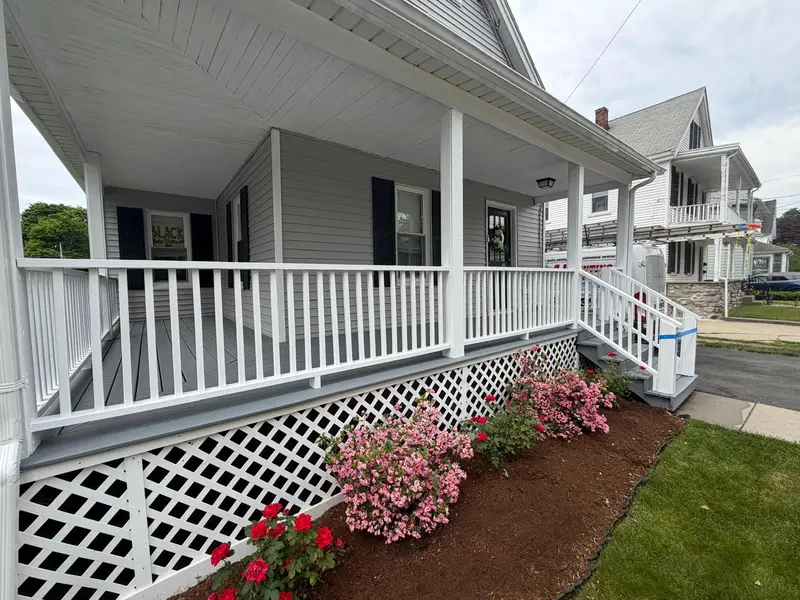
A Norwood home's front and back porches: floor boards and steps painted gray, with railings, balusters and lattice skirting in white.
See the photos →Decks, porch floors, stairs and railings cleaned, repaired and coated with a stain or paint matched to the wood, the shade and the foot traffic.
Outdoor living space here takes several forms. Detached single-family houses make up 47.4% of the housing, and on those the deck is one owner's decision. The older multi-family stock, described in the city's Housing Strategy Plan as wooden buildings on small individual lots, has less yard to work with, so the wood that needs coating may be a porch floor or a run of exterior stairs rather than a freestanding deck. Each calls for a different coating approach.
Whatever the structure, horizontal wood fails first. Snow sits on it, water pools in the board gaps, and the sun hits the top surface all summer, so a deck finish wears out well before the paint on the wall next to it.
Once a film-forming coating is on the boards, switching back to a penetrating stain means stripping to bare wood. Our paint versus stain comparison explains the trade-offs over several seasons.
With 81.4% of local housing built before 1980, an old porch floor or set of back stairs may have lead-based paint under its top layers. Outdoors, EPA lead-safe work practices apply once more than 20 square feet is disturbed, which a full porch floor easily exceeds. That changes how the old coating is removed: wet scraping, ground covers and daily cleanup rather than dry sanding into the yard. The lead-safe painting page covers the method.
On a two- or three-family building, rear stairs may serve as a second way out for upstairs tenants, so the schedule matters. One flight or one landing can be done at a time, with the coating given enough dry time before it is walked on again.
Decks that sit under trees stay damp longer, grow mildew and algae, and collect leaf stains in fall. D.W. Field Park, about 650 acres spanning northern Brockton and southern Avon, is ringed by a band of woodland between its parkway and its boundary, and a yard that backs onto tree cover like that gets the same shade and leaf fall. Those boards benefit from a mildewcide-treated product, careful cleaning, and a gap between board edges kept free of debris.
Full-sun decks have the opposite problem: UV breaks down the stain on the top surfaces while the railings stay in good shape. On those, recoating the floor more often than the rails is a sensible way to manage cost.
Each new coat should follow the same steps: wash with a wood cleaner, rinse, brighten the wood to neutralize the cleaner, sand fuzzy or raised fibers, and let the boards dry thoroughly. Loose nails are reset or swapped for screws, and soft boards at stair treads and post bases are replaced first. Stain needs a stretch of dry weather to cure, so the workable window runs roughly from late spring into early fall. See how deck stain holds up through a New England winter for product notes.
If the house is also due for paint, doing the siding and trim first protects the freshly stained deck from drips; the exterior painting page covers that part.
| Single-family detached homes | 47.4% of units (17,901) (U.S. Census ACS 2020–2024 5-year, table B25024) |
| Housing built before 1980 | 81.4% of units (U.S. Census ACS 2020–2024 5-year, table B25034) |
| D.W. Field Park | About 650 acres (Brockton and Avon), chain of 7 man-made water bodies, woodland perimeter (National Register nomination, D.W. Field Park (listed 2000)) |
| Owner-occupied housing | 57.4% of occupied units (U.S. Census ACS 2020–2024 5-year, table B25003) |
These jobs were in other towns, not in Brockton. Each card names the town where the work was done.
A Norwood home's front and back porches: floor boards and steps painted gray, with railings, balusters and lattice skirting in white.
See the photos →Probably, after cleaning and brightening. Splash some water on it: if the drops soak in within a few minutes, the wood is ready to accept stain. If they bead, it needs more drying time or the mill glaze has to be sanded off.
Not without stripping to bare wood, because stain cannot soak through old paint. On older stairs, any removal is done with lead-safe methods, and repainting with a porch enamel after proper scraping is often the more practical option.
Clean it with a product that kills mildew rather than just bleaching it, let it dry fully, and choose a stain with a mildewcide. Trimming branches to let in more light and air helps more than any coating.
Staining is maintenance, not rebuilding, so it is a much smaller project, though board repairs and stripping old film add to it. The deck staining cost page gathers Massachusetts market figures; your estimate is written after we see the deck.
Semi-transparent stains on sunny floors may need attention every two to three years; solid stains and enamels last longer on the surface but need more prep when they fail. Railings and vertical parts usually outlast the floor.
Yes, including Montello, Campello and Brockton Heights.
We check the boards, the old coating and any repairs, then send a written estimate. Call (508) 258-4325, Monday–Saturday.
5.0 on Google · 35 verified reviews · Licensed & insured · Written quote in 48h