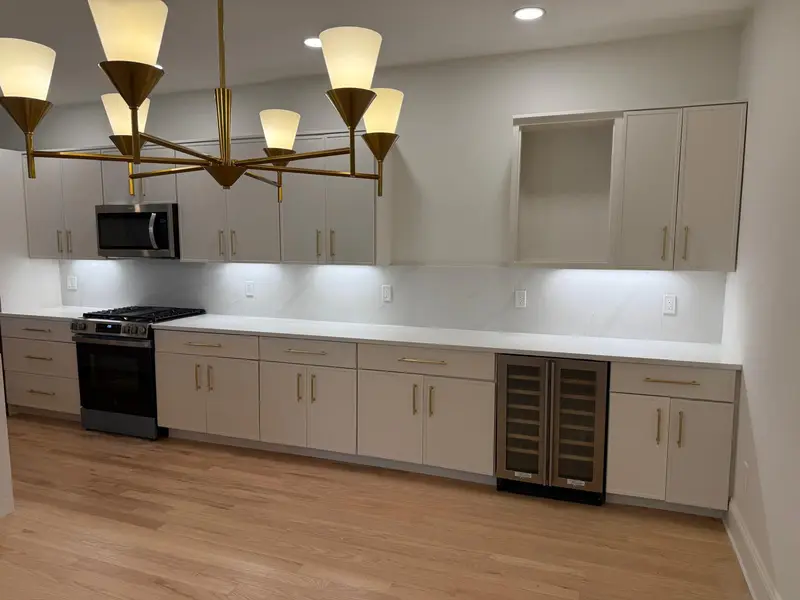
Cabinet painting, ShirleyIs the kitchen in your Shirley house a good candidate for paint?
Census estimates put the median year built for the town at 1984, and 721 housing units (29.9%) went up in the 1980s and 1990s alone. A kitchen original to a house from those years is now roughly 27 to 46 years old. The doors may still be solid and square while the finish has yellowed, worn through at the pulls, or simply gone out of style.
That combination is where paint makes the most sense: the structure is sound, and only the surface needs work. Whether it pays off depends on what the cabinets are made of, how they are built, and what the layout of the kitchen asks of them.
Read the material before you pick a color
- Solid wood doors with plywood boxes are the best case. They sand, prime and hold enamel well.
- Oak has open grain that telegraphs through paint as a pattern of small pits. If you want a smooth look, the grain has to be filled before priming; if you don't mind texture, it can be left.
- Maple and cherry have tight grain and paint smoothly, though cherry may bleed tannin through some primers unless a stain-blocking primer is used.
- Thermofoil (a vinyl skin over MDF) is a poor candidate. The skin often lifts near the oven and dishwasher, and paint won't stop that.
- Laminate or melamine can be painted with a bonding primer, but edges chip more easily than on wood.
Refinish, reface or replace
Paint keeps your existing boxes, doors and layout, so it suits a kitchen that works but looks dated. Refacing swaps in new doors and drawer fronts over the old boxes. Replacing everything is the route when boxes are water-damaged, sagging, or the layout itself is the problem. Our refinish vs. replace guide and the post on cabinet painting vs. replacement go through the trade-offs in detail.
Check under the sink first. Swollen particleboard or a soft floor in the sink base means a leak has been at work, and that box needs repair or replacement no matter which option you choose.
Built-ins in the older houses
Roughly one housing unit in five in town dates from 1939 or earlier, though the Census estimate is uncertain by about 219 units either way. Kitchens and pantries in houses that old may have built-in cupboards that have been painted several times over. Those layers can hide crisp edges and make doors stick.
For a house built before 1978, assume the lower layers could contain lead until a test shows otherwise. Sanding or stripping those cupboards is regulated work under the EPA Renovation, Repair and Painting rule, with containment and HEPA dust control. Our lead-safe painting page explains what that involves.
How a durable cabinet finish gets built
Doors and drawer fronts come off and get labeled so each returns to its own opening. Every surface is degreased, because cooking residue left on the surface is a common reason paint fails on cabinets. Then comes a scuff sand, a bonding or stain-blocking primer, light sanding between coats, and two coats of a cabinet-grade enamel such as a waterborne alkyd or urethane-modified acrylic.
Those enamels dry quickly but take days to weeks to reach full hardness, so the doors need gentle use at first. The kitchen cabinet painting process post walks through each step.
If you rent, or the kitchen is shared
About 22.6% of occupied homes in town are rented, and 356 units sit in buildings of 5 to 49 units. In a rental, the landlord's written permission comes before any cabinet work. In a building with an association, check the rules on work hours and contractor insurance before booking. For walls and trim in the rest of the house, see interior painting in Shirley.
Shirley at a glance