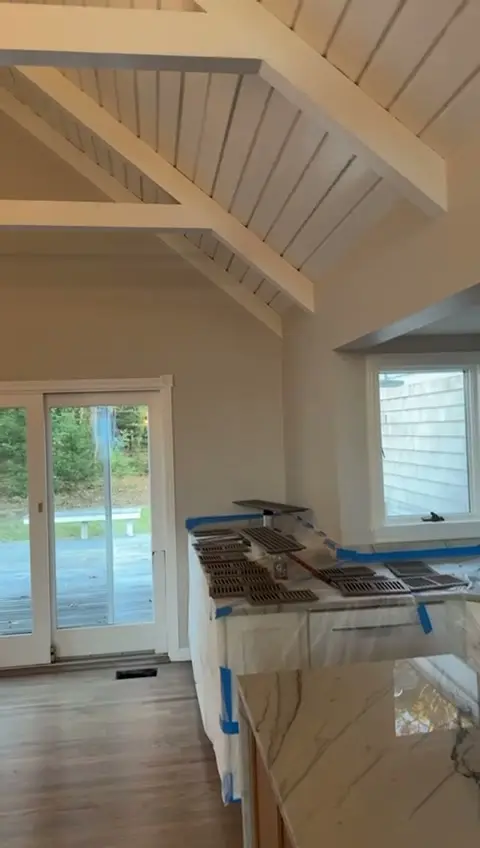
Interior painting, ArlingtonPainting inside an Arlington house usually means painting inside an older one
Census estimates put the median construction year of Arlington's housing at 1945, and 47.1% of units were built in 1939 or earlier. Only about 8% went up in 2000 or later. In a house that age, a wall can carry decades of earlier coats, and each of them stays underneath whatever goes on next.
That history shapes the job more than the color does. Old coats can be oil-based, chalky or poorly bonded, and a new latex finish applied over them without the right primer may peel in sheets. The first part of an estimate for an older interior is finding out what is already there.
Plaster walls and ceilings
A house from the 1880–1940 build-out that hasn't been gutted may still have plaster on wood or metal lath. Plaster takes paint well, but it moves differently from drywall. Hairline cracks open along ceiling joists and around door frames, and plaster that has let go of its lath sags or sounds hollow when tapped.
Cracks get cut out and filled with a setting compound rather than covered with a flexible caulk that will show through. Loose sections need to be reattached before anyone paints over them, because new paint adds weight and will not hold a failing ceiling in place.
- Patch and skim cracked or pitted plaster
- Spot-prime water stains so they don't bleed through
- Seal bare patches before finish coats
- Choose sheen by room: flat ceilings, eggshell or matte walls, harder enamel on trim
Trim, doors and stairways from several eras
The Massachusetts Historical Commission's 1980 survey of the town describes Queen Anne and Colonial Revival two-family houses from about 1900 to 1915 filling large areas on both sides of Mass. Ave. east of Spy Pond, and plain Colonial Revival and stuccoed Craftsman two-families making up the bulk of building from 1915 to 1940. If your house dates from one of those periods and keeps its original casings, baseboards and stair balusters, that woodwork will take far more brush time than the walls.
Decades of repainting can blur the original profiles. One option is stripping back the worst areas to recover the detail; the other is careful sanding and a clean, durable enamel over what is there. Either way, the condition of the trim is what drives the schedule, so it belongs in the written estimate room by room.
Lead paint is a real factor here
About 85.8% of the town's housing units were built before 1980, a span that includes the 1978 federal ban on lead-based residential paint. Under the EPA's Renovation, Repair and Painting Rule, paid work that disturbs paint in a pre-1978 home must be done by a certified firm using certified renovators, with containment and cleanup to match. Scraping, sanding and cutting into old surfaces are the kinds of work it targets.
The rule also covers rentals. A homeowner painting their own house is generally exempt, but the exemption ends if any part of the home is rented, which matters in a town where 38.4% of occupied units are renter-occupied. Our lead-safe painting page explains what the process looks like on the day.
Two-families, rentals and occupied homes
Two-unit buildings hold 23.9% of Arlington's housing units. In a two-family, interior work can involve a shared front hall, a back stair or a tenant's schedule. Refreshing the unit you live in and turning over the other one between leases call for different plans: the first can go room by room around the household, while the second is easiest to finish inside the vacancy.
Whether the house sits in East Arlington, near Arlington Center or up in the Heights, the visit covers the same ground: what is on the walls now, which rooms are occupied, and what has to be finished by when. If the outside needs work too, see exterior painting in Arlington.
Arlington at a glance