
Norwood, MA
Porch Floor, Steps & Railings in Norwood, MA
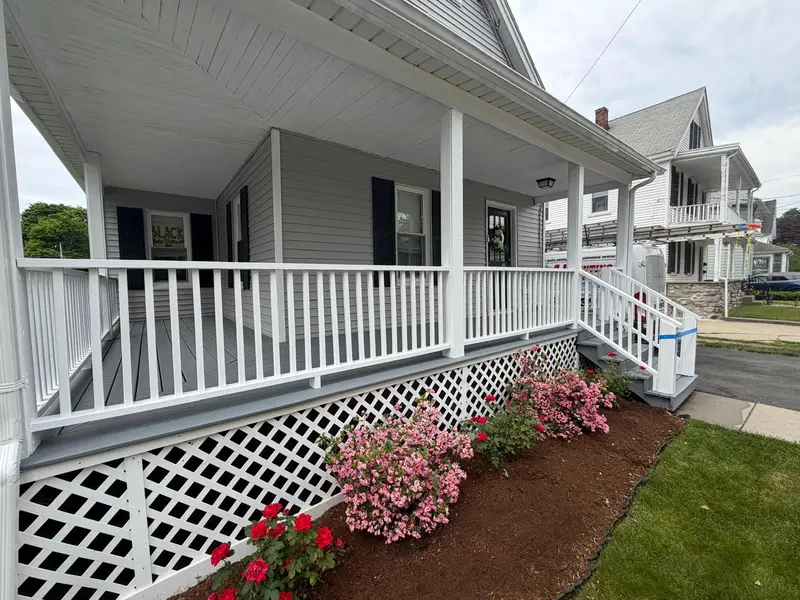
A Norwood home's front and back porches: floor boards and steps painted gray, with railings, balusters and lattice skirting in white.
See the photos →Washing, board repairs and stain or paint for decks, porches, railings and outdoor stairs, with the product picked for your wood and the shade over your yard.
Single-family detached houses make up 62.5% of the town's housing units, and 78.2% of occupied homes are owner-occupied. If you own one of those houses, the deck, porch and outdoor stairs are yours to maintain. The town's master plan counts over 5,100 residential structures from the 1980s and 1990s alone, a period it ties to large-scale single-family subdivisions. Any deck original to one of those homes has been through decades of New England winters.
Deck wood wears faster than siding because it lies flat. Rain and snowmelt sit on it, sun hits it all afternoon, and boots and furniture grind the finish away. Staining it well is mostly about cleaning and drying the wood properly first.
The master plan reports forest as 46.1% of land in town, mostly oak, red maple and white pine. A deck under those trees collects acorns, pine needles, pollen and wet leaf mats. Leaves left on boards hold moisture against the wood and can leave dark tannin stains, and the shaded parts of the deck stay damp long enough for mildew and algae to grow.
On a deck like that, prep usually means a wood cleaner to remove growth and graying, a rinse, a brightener to restore the color of the fibers, and then several dry days before any stain goes on. Clearing the gaps between boards lets water drain instead of sitting on the joists below.
Paint and solid-color stain form a surface film. On railings, balusters, fascia and lattice that film can look sharp and last, but on the walking surface it wears through in traffic lanes and peels where water stands. Recoating then means scraping the loose areas first. Penetrating semi-transparent and transparent stains soak into the wood instead, fade more evenly and are simpler to refresh.
One workable compromise is solid stain or paint on the rails and trim with a penetrating stain on the floor boards. Our post on deck stain and New England winters explains how each type handles freeze-thaw.
Before choosing a product, confirm what the deck is made of. The species decides how it is cleaned, how long new boards must weather and which stains will soak in.
Single-family attached homes, the townhouse-style units the Census counts separately, make up 9.9% of local housing. If your deck belongs to one of those, the association may control the stain color or treat the deck as a limited common element. Check the condo documents or ask the board first; our condo painting page covers how association approval works.
Older houses have their own deck issue: if a porch or deck was painted before 1978, the old coating may contain lead and should be scraped with lead-safe methods. The lead-safe painting page has the details.
| Single-family detached share of housing | 62.5% (8,129 of 13,011 units) (U.S. Census ACS 2020–2024 5-year, table B25024) |
| Forest share of town land | 46.1%, mainly oak, red maple and white pine (Town of Franklin Master Plan, Final Report (January 2025), Ch. 7) |
| Residential structures built in the 1980s–1990s | Over 5,100 (Town of Franklin Master Plan, Final Report (January 2025), Ch. 6) |
| Single-family attached (townhouse) units | 9.9% of housing units (U.S. Census ACS 2020–2024 5-year, table B25024) |
These jobs were in other towns, not in Franklin. Each card names the town where the work was done.
A Norwood home's front and back porches: floor boards and steps painted gray, with railings, balusters and lattice skirting in white.
See the photos →Stain alone will not. The growth has to be killed and washed off first, and the deck has to dry fully before staining. Afterward, sweeping off leaves and needles regularly and trimming branches to let in more sun slows the return of mildew.
Freshly treated lumber is often saturated. A simple check is to sprinkle water on a board: if it beads up, wait; if it soaks in within a few minutes, the wood is ready. That can take weeks to months depending on the lumber and the weather.
Paint holds up well on vertical parts like railings and skirting, but on floor boards it tends to peel where water collects and wear where people walk. Penetrating stain on the floor and paint or solid stain on the rails is a durable combination.
Yes, if the forecast gives several dry days with temperatures above the stain's minimum and the boards are not wet with dew. Late-season jobs are scheduled around the weather, and cold nights can slow curing.
Square footage, railing count, stairs and the condition of the old finish matter most. Our Massachusetts deck staining cost guide lists current market ranges; a free visit gives you a written estimate for your deck.
Book a free on-site visit for a written estimate covering cleaning, repairs and finish. Licensed and insured. Call (508) 258-4325.
5.0 on Google · 35 verified reviews · Licensed & insured · Written quote in 48h