
Norwood, MA
Porch Floor, Steps & Railings in Norwood, MA
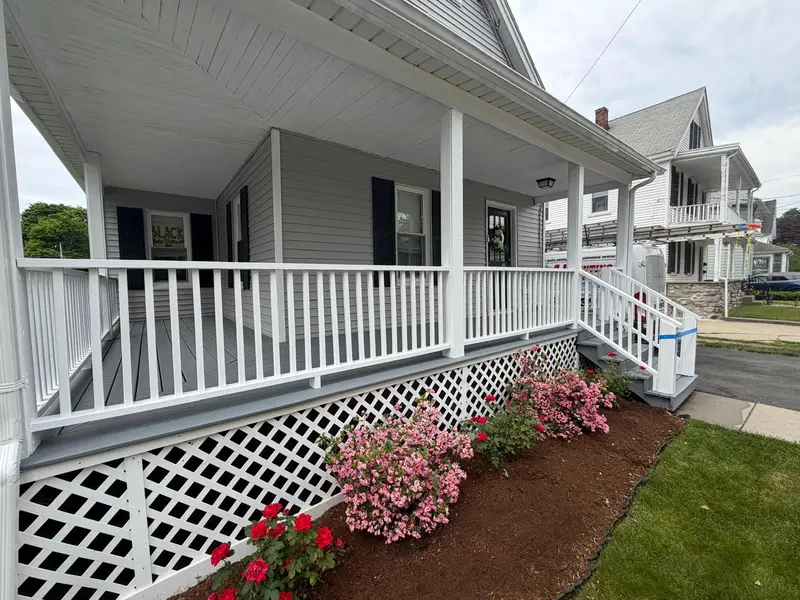
A Norwood home's front and back porches: floor boards and steps painted gray, with railings, balusters and lattice skirting in white.
See the photos →Cleaning, repairing and staining or painting decks, porches, railings and stairs on East Bridgewater properties.
The town's master plan reports that forest covers 40.9% of East Bridgewater's land, and wetlands and water another 20.5%. The same plan reports that land in residential lots larger than half an acre grew from about 1,541 acres in 1971 to about 2,261 acres in 1999. Where a lot backs onto trees, the deck gets shade, leaf litter and slow drying after rain.
Those conditions decide which finish will hold and how often it needs attention. A deck in deep shade near wet ground fails differently from one baking on the south side of the house.
Pressure-treated southern pine is the usual framing and decking on backyard decks. New boards can be too wet to absorb stain; sprinkle water on them, and if it beads, give them more time. Cedar and mahogany take penetrating oils well and look best with a semi-transparent stain. Painted fir porch floors on older houses need a porch-and-floor enamel, not deck stain.
Composite and PVC decking doesn't need stain, but the wood railings, posts and stair stringers attached to it often do.
Boards that stay damp grow mildew and algae, which turn slippery and stain the wood dark. Leaves packed in the gaps between boards hold water against the edges and start rot. On a low deck close to soggy soil, moisture rises from below, and film-forming finishes blister and peel from the underside.
On those decks a penetrating stain usually lasts better than paint or solid stain, because it lets the wood breathe and wears away instead of peeling. Clearing the gaps, improving airflow under the deck and trimming overhanging limbs help any finish.
Floors take the most abuse from feet, standing water and snow. Rails, balusters and fascia shed water and take less wear, so a solid color holds up better there. One combination is a solid color on the rail system with a semi-transparent stain on the floor boards, which avoids a film peeling underfoot. Our paint vs. stain comparison explains each option.
If the deck was painted years ago and the house is older than 1978, the old coating on a porch floor or rail could contain lead. Scraping it calls for lead-safe methods; see the lead-safe painting page.
Stain needs a run of dry days, temperatures within the label range, and no rain for several hours after the last coat. In fall, morning dew and falling leaves shorten the working day. An estimate done in the off-season lets cleaning and repairs be planned for the first dry stretch of spring. The post on deck stain through a New England winter covers what freeze-thaw cycles do to each finish. For siding and trim, see exterior painting in East Bridgewater.
| Forest share of town land | 40.9% (Town of East Bridgewater Master Plan (Oct 2024), community profile) |
| Wetlands and water | 20.5% of town land (Town of East Bridgewater Master Plan (Oct 2024), community profile) |
| Land in residential lots over 1/2 acre (1999) | 2,261.11 acres, up from 1,540.63 in 1971 (Town of East Bridgewater Master Plan (Oct 2024), History of Growth, Table 3) |
| Single-family detached homes | 81.4% of housing units (U.S. Census ACS 2020–2024 5-year, table B25024) |
These jobs were in other towns, not in East Bridgewater. Each card names the town where the work was done.
A Norwood home's front and back porches: floor boards and steps painted gray, with railings, balusters and lattice skirting in white.
See the photos →A penetrating semi-transparent stain with a mildewcide is usually the better choice on a shaded, damp deck, because it doesn't trap moisture under a film. Pair it with clearing debris from between boards and opening airflow underneath.
Solid stain behaves like paint on a walking surface. Water gets in through cracks and end grain, can't escape, and lifts the coating. Re-coating over it won't last; the loose finish has to be stripped first.
When water soaks into the boards instead of beading. For kiln-dried lumber that can be soon after construction; for wet-treated lumber it can take months. Staining too early means the stain sits on the surface and wears off.
No. Railings and balusters can take a solid stain or paint that would peel on the floor, because they shed water and don't get foot traffic. Using solid color on rails and a semi-transparent stain on the boards works well because each part gets the finish suited to its wear.
Stairs, railings and how much stripping or board replacement is needed drive the price more than deck size alone. See the deck staining cost guide for Massachusetts market data; a free site visit gives you a written estimate.
It depends on sun, shade and traffic, so check rather than follow a calendar. When water stops beading on the boards and the color has faded in the walk paths, it's time for a cleaning and a fresh coat.
AJ Painting is licensed and insured. Call (508) 258-4325, Monday to Saturday, 7AM to 6PM, to set up a free on-site visit and written estimate.
5.0 on Google · 35 verified reviews · Licensed & insured · Written quote in 48h