
Location not listed
Dental Office Waiting Room
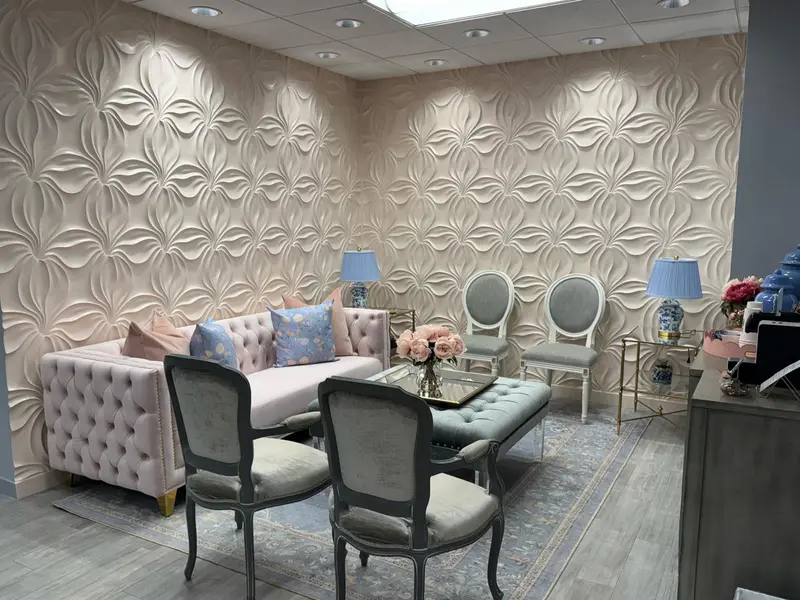
A dental practice's waiting room and reception area, finished in soft gray with applied panel molding, next to a sculpted floral feature wall.
See the photos →Painting for condo owners inside their units and for associations that need hallways, stairwells, entry doors and exteriors done.
Outside the detached single-family stock, Rockland's housing splits several ways. The Census counts 10.6% of units in single-family attached buildings, 12.3% in two-unit buildings, 8.3% in three- and four-unit buildings, and 9.3% in buildings of five or more units. The survey records building size, not ownership form, so it can't say how many of those are condominiums. A townhouse row, a converted two-family or a larger complex can each be organized as a condo, or not.
If yours is a condo, the master deed and bylaws decide who is responsible for which surfaces, and that answer shapes every painting decision.
Interior walls, ceilings and trim inside the unit are generally the owner's to paint. Hallways, stairwells, lobbies, siding and exterior trim are typically common areas maintained by the association. The gray zones are entry doors that face a shared hallway, balconies and decks, and window sash, which documents treat differently from one association to the next. Reading the master deed before choosing a door color avoids repainting it.
Some associations also set rules for unit work: allowed hours, elevator padding, where materials can be staged, and notice to the manager. Those rules apply to the painter as much as to the owner.
Property managers and boards may ask a contractor for a certificate of insurance before anyone works in a building. AJ Painting is licensed and insured, so a certificate can be requested and sent to the manager ahead of the start date. For association-wide projects, a written scope listing every hallway, door and stair run keeps the bid comparable when the board collects more than one.
Census figures put 68.2% of the town's housing units in buildings from before 1980, and the EPA's renovation rule applies to paid paint work in pre-1978 houses and apartments. For a condo unit, the firm gives the owner the EPA lead pamphlet before work begins, plus an adult occupant if the owner rents the unit out.
Common areas carry an extra step. When work disturbs paint in the shared spaces of a pre-1978 multi-unit building, the owner of those common areas (for a condo, the association) receives the pamphlet, and affected units get either written notice before work starts or signs posted during the work, describing what is being done, where, and the expected dates. In a stairwell, that covers scraping on railings, balusters, treads and door frames. Our lead-safe painting page covers containment and cleanup.
Residents still need the stairs and halls while they're being painted. Working one floor or one section at a time, keeping a clear path, and posting wet-paint signs lets people get in and out. A low-odor, low-VOC paint helps in enclosed stairwells; see low-VOC vs. zero-VOC paint. For hallway walls, a scrubbable eggshell or satin resists scuffs from moving day and grocery bags better than flat paint.
Association exterior projects follow the same prep as a house; see exterior painting in Rockland. A deck assigned to one unit may be a limited common element, and the deck staining page covers wood and stain choice. For work inside a unit, the interior painting page goes into plaster and trim, and the Hatherly page has notes for that area.
| Single-family attached units | 10.6% of housing units (753) (U.S. Census ACS 2020–2024 5-year, table B25024) |
| Units in 2–4-unit buildings | 1,468 units (20.6%): 876 in two-unit, 592 in 3–4-unit buildings (U.S. Census ACS 2020–2024 5-year, table B25024) |
| Units in buildings of 5 or more | 661 units (9.3%) (U.S. Census ACS 2020–2024 5-year, table B25024) |
| Renter-occupied homes | 23.5% of occupied units (1,623) (U.S. Census ACS 2020–2024 5-year, table B25003) |
These jobs were in other towns, not in Rockland. Each card names the town where the work was done.
A dental practice's waiting room and reception area, finished in soft gray with applied panel molding, next to a sculpted floral feature wall.
See the photos →Usually not for walls and ceilings, but check your bylaws and rules for work hours, notice to the manager, and anything about doors or windows that face common areas. If an approval is needed, those documents will say so.
Yes. AJ Painting is licensed and insured, and a certificate can be sent to the manager or association before the job is scheduled.
Because it's a pre-1978 common area, the federal lead rule applies: the association, as owner of the common areas, gets the EPA lead pamphlet, the affected units get written notice or see posted signs about the work, and scraping happens inside containment with a verified cleanup afterward.
It depends on the master deed. Some treat the door as part of the unit, others as a common element the association maintains and colors uniformly. The document, not habit, decides.
For a unit, it's the same factors as any interior. For an association, add the number of floors, stair runs, doors, after-hours scheduling and lead requirements. The Massachusetts painting cost guide shows market data, and either kind of job gets a written estimate after a free visit.
Yes. Painting a section at a time with a clear walkway, signs on wet surfaces, and a low-odor paint keeps the building open. In pre-1978 buildings, areas where paint is being scraped stay closed until cleanup passes.
AJ Painting is licensed and insured. Call (508) 258-4325, open 7AM–6PM Monday through Saturday, for a free on-site visit and a written scope and estimate.
5.0 on Google · 35 verified reviews · Licensed & insured · Written quote in 48h